
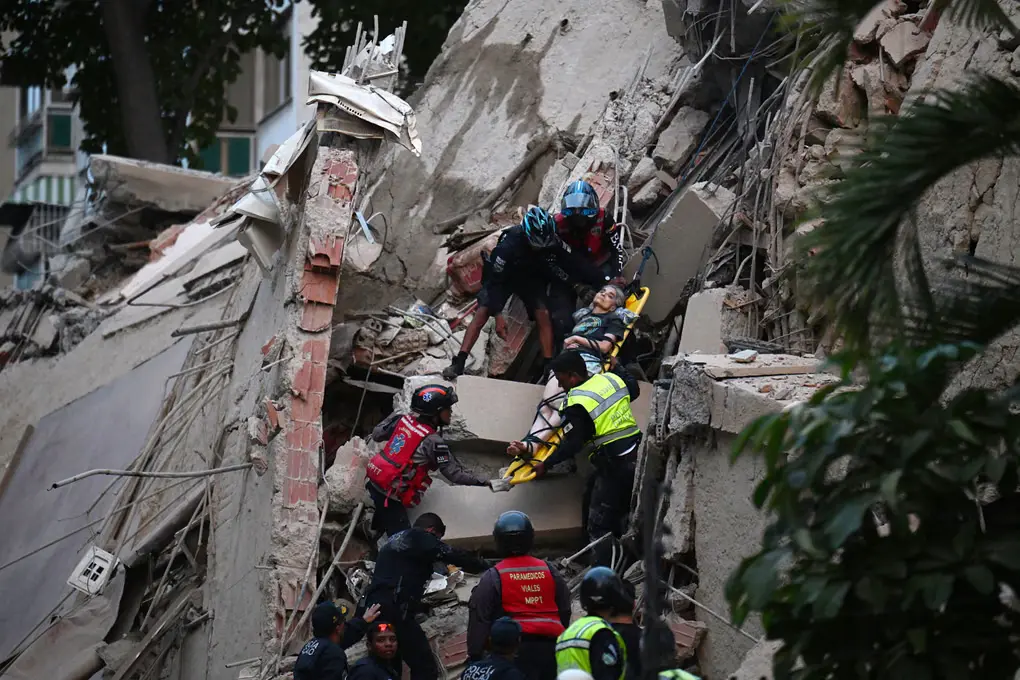
CARACAS, Venezuela — A state of emergency has been declared across Venezuela after the country was struck by two of the most powerful back-to-back earthquakes in its modern history. The rare seismic “doublet” leveled multiple high-rise buildings in the capital city of Caracas, leaving rescue workers scrambling through shattered concrete to pull survivors from the rubble as night fell.
The catastrophic event occurred shortly after 6:00 PM local time on Wednesday, June 24, 2026, catching millions of residents by surprise on a national public holiday.
39 Seconds of Terror
According to data compiled by the US Geological Survey (USGS), the disaster unfolded in rapid, violent succession:
- The Foreshock (18:04 local time): A magnitude 7.2 earthquake struck at a depth of roughly 13 kilometers (8 miles), centered along Venezuela’s Caribbean coast just west of the community of Morón.
- The Mainshock (39 seconds later): While residents were still fleeing into the streets, an even larger magnitude 7.5 earthquake ripped through the region, registering as the strongest seismic event to hit the nation in more than a century.
The violent shaking tore through north-central Venezuela and was felt over vast stretches of the country.
Caracas Devastated as High-Rises Collapse
The worst of the structural devastation concentrated heavily in Caracas and the neighboring coastal city of La Guaira. Billows of thick dust choked the air in the capital as residential and commercial structures folded under the seismic stress.
Interior Minister Diosdado Cabello reported “very alarming” situations across the city, noting that multiple buildings and homes have collapsed entirely.
- In the upmarket district of Altamira, home to numerous foreign embassies, witnesses saw at least three multi-story buildings collapse into piles of debris.
- In the Chacao district, Mayor Gustavo Duque confirmed that four buildings completely collapsed, and 22 people were rushed to the hospital.
- In the Baruta suburb, a landslide triggered by the quakes buried structures, prompting civil defense workers to scramble with stretchers to rescue survivors from the mud and rubble.
Local authorities immediately halted the Caracas Metro and train systems to prevent further casualties.
Logistical Freeze: In La Guaira, the nation’s primary international travel hub, Simón Bolívar International Airport, sustained “severe damage.” Videos on social media showed scenes of panic as passengers raced through corridors seeking cover from falling ceiling panels and plaster. The airport has been closed indefinitely. Nearby, the large beachfront Eduard’s Hotel Boutique was almost completely destroyed, and the national naval academy in Catia La Mar suffered extensive structural failures.
Grim Toll Expected to Rise Exponentially
Addressing the nation via a televised broadcast, Venezuela’s interim leader Delcy Rodríguez confirmed the state of emergency and urged citizens to evacuate any damaged structures. Initial figures listed 32 confirmed deaths and over 700 injuries, but authorities expect these numbers to surge as search teams dig deeper into the rubble.
Seismologists and disaster modeling agencies have issued highly alarming projections regarding the ultimate loss of life:
- The USGS issued a warning that “high casualties and extensive damage are probable and the disaster is likely widespread.”
- Predictive models estimate a substantial 37% to 41% probability that total fatalities will fall between 10,000 and 100,000 people due to dense urban vulnerability and widespread infrastructure failure.
The Recovery Effort Begins
International help is mobilizing rapidly. US President Donald Trump announced that the United States is “ready, willing, and able to help,” calling the scale of the twin disasters massive. Emergency crews and local volunteers face a brutal race against time to tunnel into the unstable pockets of debris before the window for finding survivors closes.
Thousands of terrified citizens spent the night camping in open plazas, sports fields, and public avenues, cradling pets and belongings as they were rattled by more than 20 significant aftershocks.