
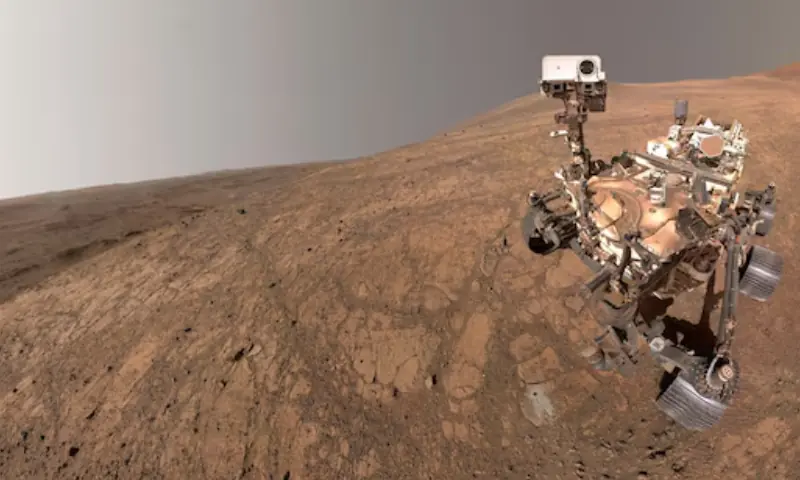
NASA Rover Finds Organic Carbon on Mars, Strengthening Case for Ancient Habitability
Scientists studying data from NASA’s Perseverance rover have gained new insights into organic carbon discovered on Mars, offering fresh clues about whether the Red Planet may once have supported life.
The findings focus on organic carbon—the essential molecular building block of all known living organisms—found in ancient sedimentary rocks inside Jezero Crater. While the presence of organic carbon is an important indicator, scientists stress that it is not proof of past life because similar compounds can also form through natural geological processes.
The research, published in the journal Science Advances, examined rocks believed to have formed between 3.2 and 3.8 billion years ago beneath an ancient lake that once filled Jezero Crater.
The organic carbon was identified in two rock samples named Cheyava Falls and Walhalla Glades, located about 100 metres apart. The discovery was first announced last year alongside evidence of a possible biosignature—a feature that could be linked to ancient microbial activity but requires further investigation before any conclusions can be drawn.
NASA previously released images of the Cheyava Falls rock, revealing fine-grained reddish mudstone with ring-shaped patterns resembling leopard spots and dark specks similar to poppy seeds. On Earth, similar features are sometimes associated with microbial processes, although they can also form through non-biological mechanisms.
Using Perseverance’s SHERLOC instrument, researchers carried out a detailed analysis of a complex form of organic material known as macromolecular carbon. They found that its chemical structure resembles carbon produced through both biological and non-biological processes on Earth, as well as carbon found in meteorites that formed without life.
This is the first time macromolecular carbon has been detected in mudstones within Jezero Crater. NASA’s Curiosity rover had previously discovered similar material in Gale Crater, located roughly 3,700 kilometres away.
“These findings indicate that the habitability of Mars and the availability of organic materials may have been widespread across the planet billions of years ago,” said planetary scientist Kyle Uckert of NASA’s Jet Propulsion Laboratory.
He emphasized that while the results strengthen evidence that ancient Mars had the ingredients and environmental conditions needed to support life, they do not confirm whether the carbon originated from living organisms or geological processes.
Scientists say the rover’s onboard instruments are not advanced enough to determine the carbon’s exact origin. Definitive answers will likely depend on returning the Martian rock samples to Earth, where they can be examined using far more sensitive laboratory equipment.
Billions of years ago, Mars is believed to have had a thicker atmosphere, a warmer climate, and abundant liquid water on its surface. Jezero Crater, where Perseverance landed in 2021, once hosted an ancient lake fed by rivers, making it one of the most promising locations to search for signs of past microbial life.
Researchers say discovering life on Mars would be one of the most significant scientific breakthroughs in history, suggesting that life may not be unique to Earth if the right conditions exist elsewhere in the universe.