
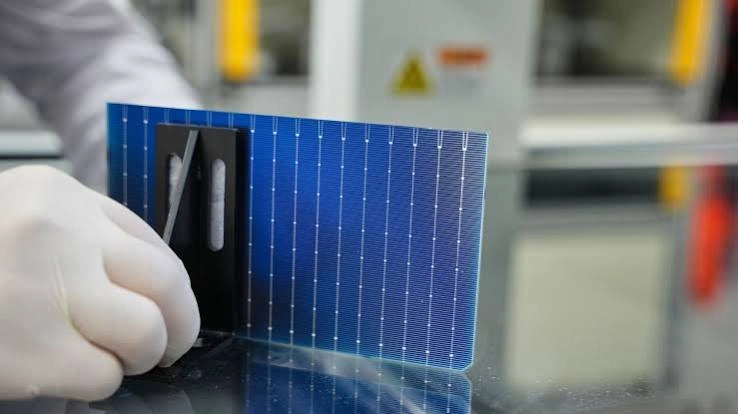
Chinese Academy of Sciences achieves a major renewable energy breakthrough with a high-efficiency, lightweight solar cell designed for future terrestrial and space applications.
Researchers at the Chinese Academy of Sciences (CAS) have achieved a significant milestone in renewable energy by developing a perovskite-organic tandem solar cell with a certified steady-state power conversion efficiency of 28.04 percent, setting a new benchmark for the technology.
The breakthrough, published in the prestigious journal Nature, highlights China’s growing leadership in next-generation solar energy research. The newly developed tandem solar cell also recorded a peak laboratory efficiency of 28.80 percent, making it one of the most efficient perovskite-based solar devices ever created.
Record-Breaking Solar Cell Performance
The research was carried out by the Institute of Chemistry at the Chinese Academy of Sciences, where scientists designed a wide-bandgap perovskite top subcell with the highest open-circuit voltage reported for its category.
When paired with an advanced organic bottom subcell, the tandem design captured a broader portion of the solar spectrum, significantly improving overall energy conversion compared to conventional silicon solar cells.
The device maintained 90 percent of its original efficiency after 625 hours of continuous illumination, demonstrating excellent long-term operational stability.
Lightweight Design for Space Applications
The project was led by Li Yongfang, an academician at the Chinese Academy of Sciences, who emphasized the technology’s unique advantages.
According to Li, the new solar cell combines high efficiency, mechanical flexibility, and an ultra-lightweight design, making it suitable not only for terrestrial renewable energy systems but also for demanding aerospace applications.
Its exceptional power-to-weight ratio could make it an ideal energy source for satellites, spacecraft, and future space stations, where reducing weight is essential.
Why Tandem Solar Cells Are More Efficient
Unlike traditional single-junction solar cells, tandem solar cells combine multiple photovoltaic materials to capture more sunlight.
In the new design:
- The perovskite layer efficiently absorbs visible light.
- The organic layer captures near-infrared wavelengths.
This dual-layer structure enables the solar cell to convert a much larger portion of sunlight into electricity, significantly boosting efficiency.
Solving a Major Stability Challenge
One of the biggest obstacles facing perovskite solar technology has been phase separation.
To maximize sunlight absorption, the perovskite film requires both iodine and bromine. However, prolonged exposure to light can cause these elements to separate, reducing voltage, efficiency, and long-term stability.
Researcher Meng Lei, a key member of the project, described this issue as one of the greatest barriers preventing commercial adoption.
Innovative Molecular Solution
To overcome this challenge, the research team introduced a specially designed molecule known as TDB into the perovskite layer.
During the manufacturing process, TDB helps keep iodine and bromine evenly distributed throughout the material. Under sunlight, TDB transforms into another compound called TAB, which settles along the edges of the perovskite crystals.
This innovative process prevents phase separation, significantly improving both durability and long-term performance under continuous illumination.
A Major Step Forward for Renewable Energy
The achievement marks another important advance in the development of next-generation photovoltaic technologies.
As global demand for clean energy continues to grow, highly efficient tandem solar cells could play a key role in reducing dependence on fossil fuels while powering homes, businesses, electric vehicles, and future space missions.
The latest breakthrough further strengthens China’s position at the forefront of renewable energy innovation and could accelerate the commercialization of high-efficiency perovskite solar technology worldwide.