
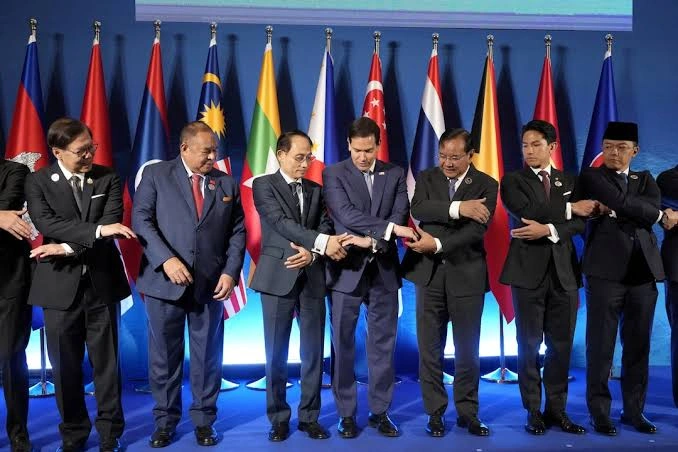
MANILA: US Secretary of State Marco Rubio and Chinese Foreign Minister Wang Yi held high-level talks on Wednesday on the sidelines of the Association of Southeast Asian Nations (ASEAN) foreign ministers’ meeting, as regional leaders expressed growing concern over escalating tensions in the Middle East and the South China Sea.
The meeting between the top diplomats comes at a critical time as Washington and Beijing seek to manage strained relations while exploring the possibility of a summit between US President Donald Trump and Chinese President Xi Jinping, which Trump has indicated could take place later in September.
Rubio had confirmed earlier this week that preparations for a potential leaders’ summit were still under consideration. However, neither Rubio nor Wang made any public remarks before their closed-door meeting.
US-China Relations Remain Fragile
The diplomatic engagement follows a fragile truce between the world’s two largest economies, with bilateral relations facing renewed pressure after President Trump accused China of attempting to interfere in US elections. Beijing has strongly rejected the allegations.
Despite ongoing disagreements over trade, security and technology, both countries continue diplomatic efforts to prevent further deterioration in relations.
ASEAN Focuses on Regional Security
The wider ASEAN ministerial gathering in Manila has been dominated by discussions on rising geopolitical tensions, particularly the renewed conflict involving the United States and Iran, as well as increasing disputes in the South China Sea.
Foreign ministers from ASEAN member states voiced serious concern over the worsening situation in the Middle East and called for restraint to prevent further regional instability.
Rubio Blames Iran for Escalation
Addressing ASEAN foreign ministers, Rubio placed responsibility for the latest escalation squarely on Iran, accusing Tehran of failing to engage sincerely in diplomatic negotiations.
“The problem we’re having right now is that they’re not serious about talks,” Rubio said.
“If they’re serious, we’re serious. If they’re not, then we will do what’s necessary to protect our interests, and also the interests of our allies,” he added.
South China Sea Dispute Adds Pressure
The ASEAN meeting also comes as tensions remain high between China and the Philippines following a recent confrontation in the South China Sea. The incident prompted both countries to summon each other’s ambassadors, further complicating regional security dynamics.
The South China Sea remains one of Asia’s most sensitive flashpoints, with overlapping territorial claims involving China, the Philippines and several Southeast Asian nations.
The latest diplomatic engagements highlight growing international efforts to manage multiple geopolitical crises simultaneously while preventing further escalation in key global hotspots.