
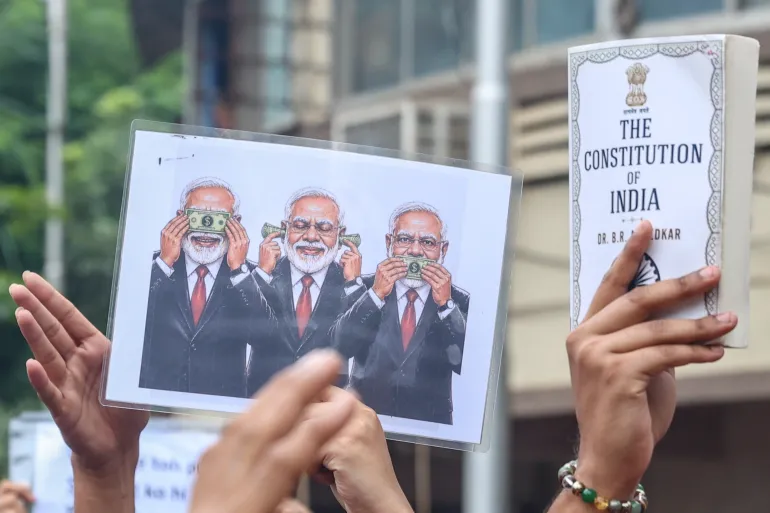
Indian Prime Minister vows swift action against paper leak accused as nationwide protests demand education reforms and minister’s resignation.
NEW DELHI: Indian Prime Minister Narendra Modi has pledged to establish fast-track courts to ensure speedy trials and strict punishment for those involved in examination paper leaks, marking his first public response to growing youth-led protests over alleged irregularities in India’s education system.
The protests have intensified across New Delhi following reports of paper leaks and other irregularities in the country’s national medical entrance examinations. Demonstrators have occupied Parliament Street for three consecutive days, with many camping on the major road connecting Parliament House to the capital’s commercial hub, Connaught Place.
Taking to social media platform X on Thursday, Modi stressed his government’s commitment to protecting students’ futures.
“Nothing is more important than the welfare and future of our youth,” Modi wrote. “We have decided to set up fast-track courts to ensure swift and stringent punishment for those involved in paper leaks. Those who try to harm the future of our youth will not be spared.”
The demonstrations are being coordinated by the Cockroach Janta Party (CJP), a satirical online movement launched in May that has evolved into a nationwide campaign demanding comprehensive examination reforms and the resignation of Education Minister Dharmendra Pradhan.
Speaking to Indian news agency ANI at the protest site in Jantar Mantar, CJP founder Abhijeet Dipke alleged that outside elements were attempting to provoke violence in order to discredit the peaceful demonstrations.
“We have been protesting here for a month without any such incidents,” Dipke said. “People are being brought in from outside to deliberately create unrest and tarnish the movement.”
Later, Dipke criticized the prime minister’s response on X, saying the government appeared “ready to shut down all of Delhi, but not sack Dharmendra Pradhan.”
Meanwhile, CJP spokesperson Ashutosh Ranka argued that creating fast-track courts alone would not resolve the deeper structural issues affecting India’s examination system. Protest leaders continue to demand greater transparency, accountability, and comprehensive reforms to restore public confidence in the country’s competitive testing process.
The controversy has sparked a broader national debate over examination security, educational governance, and the government’s handling of one of India’s most significant student movements in recent years.