
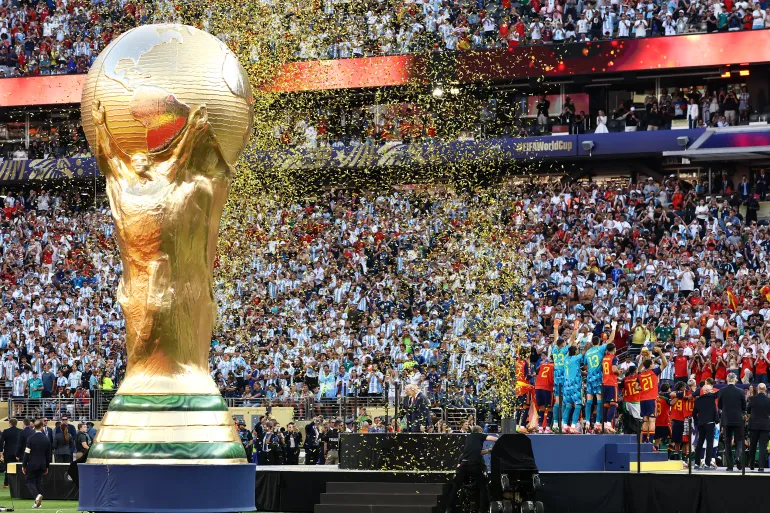
MADRID: The curtain has officially fallen on the FIFA World Cup 2026, with Spain celebrating their historic triumph while Argentina begins life after losing the world title. The tournament will be remembered as the biggest FIFA World Cup ever staged, setting new records both on and off the pitch.
Hosted jointly by the United States, Canada, and Mexico, the expanded competition featured 48 national teams, 16 stadiums, and 104 matches played over 39 days. A total of 1,039 players participated, producing 308 goals in a tournament that showcased football’s growing global reach and competitiveness.
Biggest FIFA World Cup Ever
The 2026 edition marked a new era for international football following FIFA’s expansion from 32 to 48 teams. The larger format delivered more matches, greater fan engagement, and increased opportunities for emerging football nations to compete on the world’s biggest stage.
Tournament statistics surpassed those of the 2022 FIFA World Cup in Qatar, reflecting the continued evolution of the sport and the growing quality of international competition.
FIFA World Cup 2026 by the Numbers
- Host Nations: United States, Canada, and Mexico
- Participating Teams: 48
- Players: 1,039
- Venues: 16 stadiums
- Matches Played: 104
- Tournament Duration: 39 days
- Goals Scored: 308
Kylian Mbappé Wins Second Consecutive Golden Boot
France superstar Kylian Mbappé once again dominated the scoring charts, claiming his second straight World Cup Golden Boot after scoring 10 goals and providing four assists in eight matches.
The Real Madrid forward also became the highest goalscorer in FIFA World Cup history, taking his overall tournament tally to 22 goals, surpassing Lionel Messi.
Mbappé became the first player since Gerd Müller in 1970 to reach double figures in goals during a single World Cup.
Messi Finishes Second in Scoring Race
Argentina captain Lionel Messi finished another outstanding World Cup campaign with eight goals and four assists, helping the defending champions reach the final before losing 1-0 to Spain after extra time.
Although Argentina fell short of retaining the title, Messi once again played a pivotal role throughout the tournament and concluded his World Cup career among the competition’s greatest-ever players.
Top Goalscorers – FIFA World Cup 2026
| Player | Country | Goals | Assists |
|---|---|---|---|
| Kylian Mbappé | France | 10 | 4 |
| Lionel Messi | Argentina | 8 | 4 |
| Jude Bellingham | England | 7 | 1 |
| Erling Haaland | Norway | 7 | 0 |
| Ousmane Dembélé | France | 6 | 2 |
| Harry Kane | England | 6 | 2 |
| Mikel Oyarzabal | Spain | 5 | 1 |
| Ismaïla Sarr | Senegal | 4 | 1 |
| Julián Quiñones | Mexico | 4 | 1 |
| Vinícius Júnior | Brazil | 4 | 1 |
Bellingham Makes England History
England midfielder Jude Bellingham also enjoyed a remarkable tournament, becoming the first England men’s player to score seven goals in a single FIFA World Cup. His performances helped England secure third place after a thrilling victory over France.
A New Chapter for World Football
The 2026 FIFA World Cup not only crowned a new champion in Spain but also ushered in a new era for international football. With record participation, historic individual achievements, and unprecedented global attention, the tournament reinforced the World Cup’s status as the world’s premier sporting event while setting new benchmarks for future editions.