

Lahore’s air quality fell into the “very unhealthy” category on Wednesday night, with the US Air Quality Index (AQI) reaching 210 at around 10pm, according to IQAir. The worst reading in the city, 298, came from the Urban Unit in Lahore Cantonment, as air pollution worsened across parts of Punjab.
Background
Lahore and other Punjab cities regularly face a spike in air pollution between October and January, a period commonly described as smog season. Cooler temperatures and still air trap pollutants close to the ground, which pushes AQI readings higher.
Environmental officials in past seasons have pointed to smoke from vehicles, industrial emissions and crop residue burning as major contributors, and have called for stricter enforcement against these sources. This year’s first major spike shows that the season has begun.
Details
IQAir, which uses the US AQI scale, put Lahore’s overall reading at 210. It also reported Kot Addu at 212. IQAir advised residents to limit outdoor movement, wear masks, keep windows closed and use air purifiers where possible.
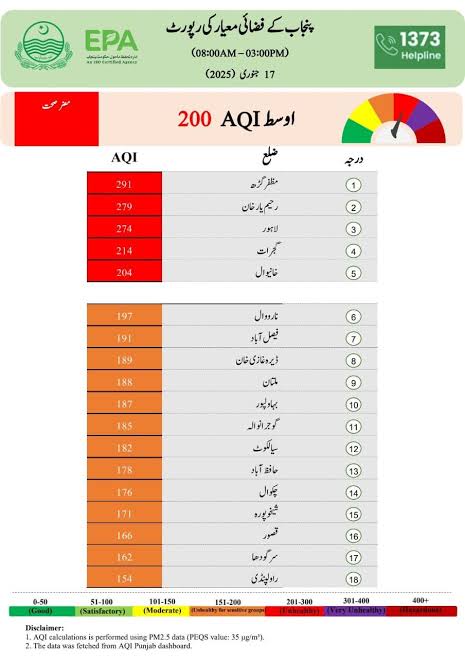
The Punjab Environment Protection Agency (EPA) reported lower figures for the same period. It recorded Kot Addu at 183, the highest in the province, followed by Vehari at 171, Jhelum at 169 and Sahiwal at 162. Multan and Pakpattan each stood at 159, Gujranwala at 157, Dera Ghazi Khan at 154 and Bhakkar at 153.
Further down the list, Sheikhupura recorded 147 and Lahore 143, while Faisalabad and Khushab each registered 137, Okara 133, Bahawalpur 127 and Mandi Bahauddin 125. Dialogue Pakistan reported that Jhang recorded 52 and Nankana Sahib had the lowest AQI in the province at 40.
The gap between the two sets of figures is notable. IQAir and the Punjab EPA use different monitoring networks and methods, so readings for the same city can vary. Levels can also change quickly within hours. For example, the Punjab government’s own AQI page showed Lahore at 126, in the moderate range, shortly after midnight.
The EPA advisory urged people vulnerable to air pollution to monitor their health, maintain healthy eating habits and avoid smoking.
Quotes
No official statement beyond the EPA advisory was included in the reports reviewed. IQAir’s guidance was direct: residents should reduce time outdoors, wear masks, keep windows shut and use air purifiers if they have them.
Impact
On the US AQI scale, a reading between 201 and 300 is considered very unhealthy, and health alerts apply to everyone, with a higher risk of serious effects for children, older adults and people with asthma or heart and lung conditions. Even a few hours of exposure can cause irritation in the eyes, nose and throat.
Daily life can be affected too. Poor visibility can disrupt traffic, and schools and workplaces often face pressure to adjust outdoor activities when air quality worsens. Low-income workers who spend long hours outside, such as street vendors and construction labourers, are among the most exposed.
Conclusion
With smog season only beginning, air quality in Lahore and other cities is likely to keep fluctuating in the coming weeks. Residents are advised to check daily AQI updates, limit outdoor exposure when levels are high, and take extra care for children and older family members.
Frequently Asked Questions
What does an AQI of 210 mean for Lahore residents?
On the US AQI scale used by IQAir, a reading of 210 falls in the “very unhealthy” range. At this level, health effects can be felt by everyone, not just sensitive groups, and people are advised to limit outdoor activity, wear masks, keep windows closed and use air purifiers where possible. Children, older adults and people with asthma, heart disease or other respiratory conditions face the highest risk and should take extra precautions.
Why do IQAir and the Punjab EPA show different AQI figures?
On Wednesday night, IQAir reported an AQI of 210 for Lahore, while the Punjab EPA recorded 143. The two use different monitoring networks, station locations and calculation methods, so figures can differ even for the same city. Readings also change quickly during the day, which is why experts suggest checking more than one source and looking at trends, not just a single number.
How can people protect themselves from smog and poor air quality?
IQAir advises limiting outdoor movement, wearing masks, keeping windows closed and using air purifiers where available. The Punjab EPA advisory adds that vulnerable people should monitor their health, maintain healthy eating habits and avoid smoking. People who experience breathing difficulty, chest pain or persistent coughing should seek medical advice instead of waiting for symptoms to pass.