

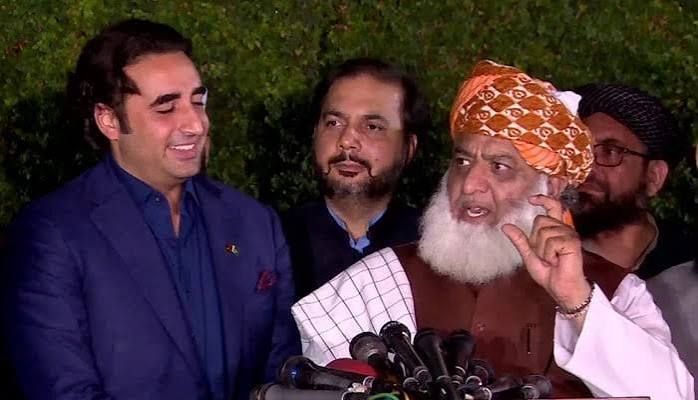
The Bilawal Fazlur Rehman call on Sunday has added a new layer to Pakistan’s political debate. Pakistan Peoples Party (PPP) Chairman Bilawal Bhutto-Zardari spoke to Jamiat Ulema-i-Islam-Fazl (JUI-F) chief Maulana Fazlur Rehman and condemned the government’s actions against him. The conversation is notable because the PPP is an ally of the ruling coalition.
Bilawal said the government should avoid steps that weaken democracy and Parliament. The call took place on the same day JUI-F workers held street protests in several cities of Khyber Pakhtunkhwa. The party says it is being targeted through propaganda and legal action.
Why the Bilawal Fazlur Rehman Call Matters Now
Relations between the government and the JUI-F chief have been tense for several weeks. On November 4, the party strongly condemned alleged drone surveillance of Maulana Fazlur Rehman’s residence. It described the act as a violation of the sanctity of his home and of basic human rights.
Two days later, the JUI-F chief hit back at the government. He accused Prime Minister Shehbaz Sharif of appearing increasingly helpless and questioned how constitutional amendments were pushed through Parliament. He also warned against political pressure and intimidation.
Bilawal had already signalled concern. He warned that confrontations with the PTI, followed by disputes with the JUI-F chief, would only add to the difficulties of ordinary citizens. Sunday’s phone call can be seen as a continuation of that message from a key coalition partner.
What Was Discussed During the Phone Call
According to a PPP statement, the two leaders exchanged views on the country’s political situation. Bilawal condemned the government’s actions and what he called political vengeance targeting the JUI-F. Reports differ slightly on who placed the call. ARY News said Maulana Fazlur Rehman contacted Bilawal, while Dawn reported that Bilawal spoke to the JUI-F chief.
Bilawal also made a broader argument about democratic norms. He said the government should tolerate opposition criticism and that a responsible opposition plays an important role in a parliamentary system. He asked the government to avoid any step that could weaken democracy or Parliament.
The call also touched on legal pressure facing the JUI-F leadership. According to a 24NewsHD report, Bilawal criticised the alleged action involving Maulana Fazlur Rehman, his son and his brothers, whose property and assets are reportedly being examined over claims of acquiring wealth through unfair means. These claims have not been proven, and the JUI-F rejects the allegations of wrongdoing.
Cases and Protests Against JUI-F Leadership
Another development raised the temperature. A terrorism case was registered against Mufti Abrar Ahmed, secretary to the JUI-F chief, according to the party’s spokesperson. The spokesperson said the charges are serious and that more than 200 unidentified party workers were also named in the case.
The party responded on the streets. JUI-F held protests in several cities of Khyber Pakhtunkhwa against what it called propaganda directed at the party and its leadership. Party leaders say such actions will not silence political dissent.
JUI-F Senator Kamran Murtaza made a similar point earlier this year. He said attempts to suppress dissent through vindictive cases have failed in the past and will fail in the future. The government has not accepted the claim that these actions are politically motivated.
What Bilawal and the PPP Said
Bilawal’s remarks were measured but pointed. In the PPP’s account, he said the government should stay away from “such actions” that weaken democracy and Parliament. The wording suggests the PPP wants to protect the political process without leaving the coalition.
Maulana Fazlur Rehman has framed his own position in strong terms in recent days. He said his struggle centres on the rights of ordinary citizens, public ownership and the economic hardship caused by inflation. He has also urged those in power to give up confrontation and act responsibly.
Possible Impact on Pakistan’s Politics
The PPP’s public criticism of the government is politically significant. The party supports the ruling coalition, so its objections carry more weight than those of a traditional opposition group. The call also shows the PPP and the JUI-F are keeping their channels open, a pattern seen in earlier meetings between the two leaders.
The effect on the wider economy and governance is harder to measure. Political tension can slow policy consensus at a time of economic pressure. Readers following that side of the story may want to see our report on <a href=”https://aapkamagazine.com/2026/10/17/pakistan-bop-swings-to-4-39-billion-deficit-in-september/”>Pakistan’s balance of payments deficit</a> and our look at how <a href=”https://aapkamagazine.com/2026/10/17/chinese-investors-eye-punjab-as-local-businesses-struggle/”>local businesses are coping with an uncertain outlook</a>.
What Could Happen Next
Much depends on how the government responds to the criticism from within its own camp. If talks between the coalition leadership and the JUI-F begin, the pressure could ease. If legal cases and street protests continue, the dispute may deepen.
The PPP is likely to keep pushing for dialogue, as Bilawal has urged in earlier statements. The JUI-F has shown it will keep using both the courts of public opinion and protest to make its case. Developments on the cases against party members will be a key signal. Follow more political updates in our <a href=”https://aapkamagazine.com/category/trending/”>Trending section</a>.
Frequently Asked Questions
What did Bilawal Bhutto-Zardari say to Maulana Fazlur Rehman?
According to the PPP statement, Bilawal condemned the government’s actions and what he described as political vengeance against the JUI-F. He said the government should tolerate criticism from the opposition and avoid steps that weaken democracy and Parliament. He also stressed that a responsible opposition is an essential part of a parliamentary system.
Why is the Bilawal Fazlur Rehman call significant?
The PPP is part of the group that supports the ruling coalition, yet its chairman publicly criticised the government’s treatment of a major opposition party. That makes the call more than a courtesy exchange. It signals that allies are uneasy about how political disputes are being handled, and it may influence how the government approaches the JUI-F going forward.
What cases have been reported against JUI-F figures?
The JUI-F spokesperson said a terrorism case was registered against Mufti Abrar Ahmed, the party chief’s secretary, and that over 200 unidentified workers were also named. Separate reports say the assets of Maulana Fazlur Rehman, his son and his brothers are being examined over allegations of acquiring wealth through unfair means. These are allegations and claims, and none has been proven in court.
How has the JUI-F responded to the pressure?
The party has issued strong statements, condemned the alleged drone surveillance of its chief’s residence, and held protests in several Khyber Pakhtunkhwa cities. Its leaders say the actions are politically motivated and will not end dissent. The party has not said it will stop its criticism of the government.
Could this affect relations between the PPP and the government?
It could add strain, but there is no sign the PPP is leaving the coalition. Bilawal’s language focused on protecting democracy and Parliament rather than on breaking ties. The PPP has also urged the government to build trust with allies and opposition, which suggests it wants to push for dialogue from the inside.
Leave a comment