

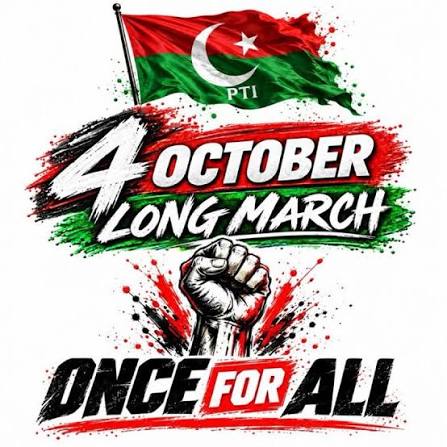
Pakistan is bracing for a tense weekend as the Pakistan Tehreek-e-Insaf (PTI) presses ahead with its planned October 4 long march to Islamabad. Government and opposition negotiating teams resumed talks on Saturday after an initial round failed to resolve major differences, leaving the country watching closely to see whether the march will go ahead as planned.
Background
PTI first announced its long march toward the federal capital in late September, originally setting September 27 as the launch date before deciding to postpone the protest to October 4. The party says the march is meant to press for faster court hearings in cases involving PTI founder Imran Khan, improved medical treatment for him at Shifa International Hospital, and an end to restrictions on visits with him.
Roads in Islamabad had already been partially blocked with shipping containers in anticipation of the march before being reopened once the date was pushed back. The announcement set off weeks of political maneuvering, including a first round of government-opposition talks that ended without a breakthrough.
Details
PTI has settled on a route for the march, with caravans from Dera Ismail Khan, Tank, South Waziristan and Bannu set to converge in Lakki Marwat before heading onward, eventually reaching Peshawar by October 6. Khyber-Pakhtunkhwa Chief Minister Sohail Afridi is expected to lead the procession, with former chief minister Ali Amin Gandapur also taking part.
On the government side, officials have signaled they could respond firmly if the situation escalates. Federal lawmaker Tariq Fazal Chaudhary said the government was seriously considering invoking emergency powers under Article 232 of the Constitution in Khyber-Pakhtunkhwa, while other officials have floated the possibility of governor’s rule in the province. PTI has strongly pushed back against both options.
Negotiations between the two sides have continued in parallel with march preparations. A first round of talks between government and PTI committees concluded on Friday without resolving the core disagreements, and both sides agreed to meet again on Saturday afternoon to continue the discussion.
Quotes
PTI chairman Barrister Gohar Ali Khan said the party’s planned march would remain a peaceful, political activity, and called on the government to avoid measures such as governor’s rule or emergency in Khyber-Pakhtunkhwa. He added that whether the march ultimately proceeds would depend on the government’s attitude during talks.
On the government’s side, Interior Minister Mohsin Naqvi said officials expected PTI to pursue its grievances through political discourse rather than confrontation, while making clear that any court orders relating to the march would be enforced. PPP chairman Bilawal Bhutto-Zardari also weighed in, welcoming the government-opposition dialogue and expressing hope the long march would be called off unconditionally.
Impact
The standoff has already had ripple effects beyond politics, with hotels in Islamabad’s Faizabad area reportedly ordered to close as authorities prepare for possible disruption. A large-scale march, combined with the threat of emergency rule in Khyber-Pakhtunkhwa, could further strain relations between the federal government and a province currently governed by PTI.
The outcome of this weekend’s talks will also shape the political climate heading into the final months of the year. A peaceful resolution through dialogue would ease tensions, while a breakdown in talks could set the stage for a prolonged standoff between the government and the opposition.
Conclusion
With negotiating committees scheduled to meet again, both sides face pressure to find common ground before October 4 PTI maintains the march will proceed regardless, while government officials continue to stress enforcement of court orders and the possibility of emergency measures. How the next round of talks unfolds is likely to determine whether Pakistan heads into next week with a resolved standoff or a major political confrontation on its streets.
Frequently Asked Questions
What is the Oct 4 long march?
The Oct 4 long march is a planned protest march organised by the Pakistan Tehreek-e-Insaf (PTI) toward Islamabad, originally scheduled for September 27 before being postponed to October 4. The march is set to begin from Lakki Marwat in Khyber-Pakhtunkhwa, with supporter caravans from Dera Ismail Khan, Tank, South Waziristan and Bannu converging before the procession moves toward the capital, with Khyber-Pakhtunkhwa Chief Minister Sohail Afridi expected to lead it. PTI has described the march as a peaceful political activity rather than an attempt to disrupt law and order, though the government has indicated it is prepared to respond firmly if the situation escalates.
Why is the Oct 4 long march taking place?
PTI says the march is being organised to press for faster progress in court cases involving party founder Imran Khan, better medical treatment for him at Shifa International Hospital, and an end to restrictions on family and legal visits with him. Party leaders have framed the protest as a political and constitutional response to what they describe as ongoing grievances, while stressing that the march is meant to remain peaceful. The government, for its part, has urged PTI to pursue these concerns through dialogue rather than street protest, warning that any move toward violence or targeting of sensitive sites would not be tolerated.
Are the government and opposition holding talks?
Yes, government and PTI negotiating committees have been in direct talks aimed at averting the march, though progress has been slow. A first round of discussions concluded on Friday without resolving major sticking points, and both sides agreed to resume negotiations on Saturday afternoon. Officials have described the dialogue and the march preparations as running on parallel tracks, meaning talks are continuing even as PTI finalises its march logistics, leaving the final outcome dependent on how both sides approach the next round of negotiations.
Leave a comment