
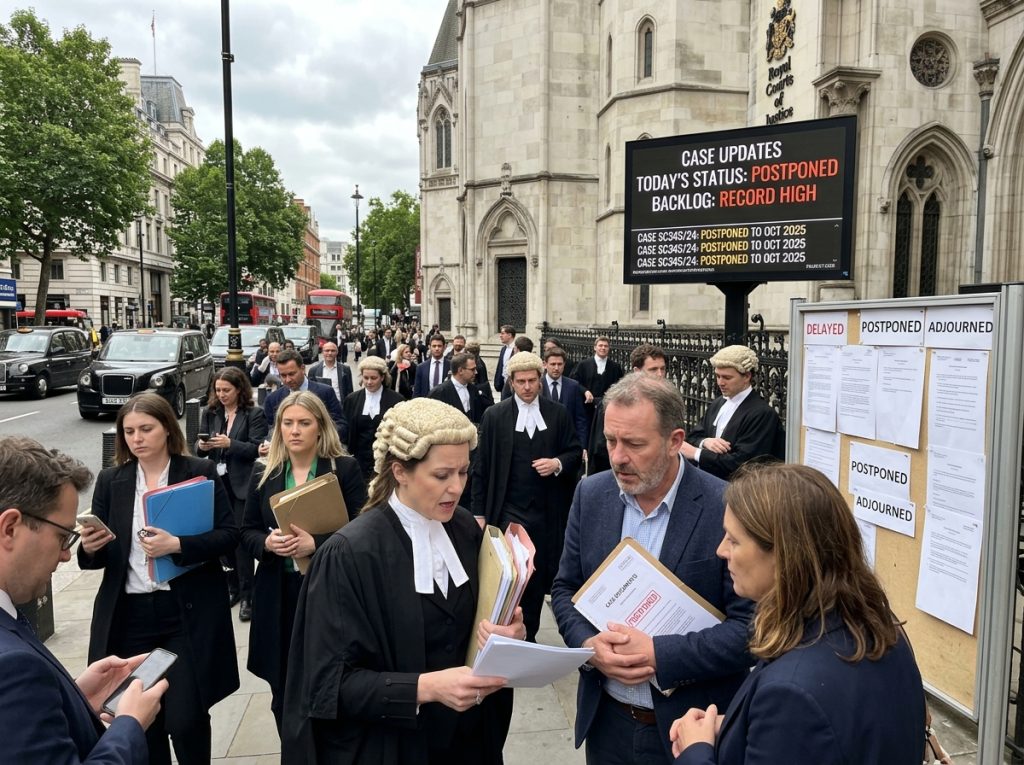

The backlog of criminal cases waiting to be heard in Crown Courts across England and Wales has climbed to a new record high of 80,829 open cases as of the end of June 2026. The average open case has now been running for more than 200 days for the first time on record, and tens of thousands of defendants and victims are experiencing repeated trial postponements as a result.
Background
The Crown Court backlog has nearly doubled over the past six years, rising from around 43,400 cases in June 2020 to today’s figure. Court closures and restricted capacity during the pandemic played an early role, but the backlog has continued to grow steadily even years after those restrictions ended, driven by staffing shortages, limited courtroom availability and a cap that, until recently, restricted how many days courts could actually sit.
That cap on Crown Court sitting days was lifted in full from 1 April 2026 following pressure from legal professional bodies, though its effect on the overall backlog is still working through the system. Magistrates’ courts, which handle less serious offences and feed cases into the Crown Court, are facing their own separate pressures, with an all-time peak of 370,222 open cases recorded in the same period.
Details
Ministry of Justice figures show a record 23,706 Crown Court cases had already been open for at least a year as of 30 June 2026, a rise of 22 percent compared with the previous year. Of those, 7,255 cases had been outstanding for two years or more, another record. The median time an open case has been sitting in the system reached 203 days at the end of June, up from 168 days just twelve months earlier.
There is no fixed legal limit on how many times a UK court case can be postponed or adjourned, which is part of why some cases drag on for years. Adjournments can be granted for reasons ranging from witness or evidence problems to courtroom or judge unavailability, legal argument, or a defendant changing their plea late. Each postponement, however, adds further strain to an already stretched system and prolongs the wait for both defendants and victims.
The picture is not uniform across the country. Analysis of the same Ministry of Justice data found that 29 of the 68 Crown Courts in England and Wales actually reduced their backlog between March and June 2026, with courts in Gloucester and Manchester Minshull Street cutting caseloads by more than 10 percent. At the other end, 38 courts saw their backlog grow over the same period, with London courts recording some of the largest increases in raw numbers.
Scotland’s court system is dealing with a similar pattern, though its position differs by case type. Summary criminal cases, which cover less serious offences, have broadly returned to pre-pandemic timescales. Solemn cases, which include the most serious offences such as murder and rape, remain far more difficult to clear. Audit Scotland reported to the Scottish Parliament’s Public Audit Committee in September 2026 that outstanding scheduled High Court trials stood at 1,002 by the end of 2025-26, nearly three times the pre-pandemic figure of 390.
Civil courts in the UK, which handle disputes between individuals and organisations rather than criminal prosecutions, are also facing lengthy waiting times, though the pressures differ from the criminal courts. Case types such as personal injury claims, housing disputes and small claims have all seen waiting times stretch well beyond pre-pandemic norms in various parts of the country, largely due to a combination of staffing shortages and rising case volumes.
Quotes
The Criminal Bar Association has repeatedly rejected the argument that juries themselves are to blame for the delays. In a statement responding to the latest figures, the organisation said the real cause has been years of governments cutting costs and capping the number of days Crown Courts are allowed to sit, describing the approach as short-sighted and damaging to the justice system over the long term.
Shadow Justice Secretary Nick Timothy criticised the government’s handling of the crisis, arguing that ministers have focused more on restricting the right to jury trials than on tackling the underlying causes of the backlog directly.
Impact
The consequences of the backlog extend well beyond frustrating delays. Victims of serious crimes, including sexual offences, often have to wait years to see their case reach trial, a situation campaigners say adds significant psychological strain and can lead some to withdraw from prosecutions altogether. Defendants awaiting trial, including those held on remand, also face prolonged uncertainty over their future.
The strain has prompted the government to explore more radical reforms, including a National Listing Framework, wider use of AI-enabled case management tools, and new “Blitz courts” set up in major English cities to clear cases more quickly, building on recommendations from the Leveson Review into court efficiency.
Conclusion
With the sitting-day cap now lifted and new reform measures beginning to roll out, officials hope the backlog will start to stabilise and eventually fall. However, current figures show the number of long-running cases is still increasing, and legal professional bodies caution that meaningful improvement will likely take years rather than months. Anyone currently waiting for a Crown Court case to be listed should expect further delays in the near term, with the next set of Ministry of Justice statistics due to show whether the reforms are having any measurable effect.
Frequently Asked Questions
What is the hardest case to win in court?
There is no single type of case that is universally the hardest to win, since outcomes depend heavily on the strength of the evidence, the quality of legal representation and the specific facts involved. That said, certain categories are widely regarded by legal professionals as particularly difficult, including cases that rely almost entirely on circumstantial evidence with no direct witness testimony, historic sexual offence allegations where evidence has degraded over time, and complex fraud or white-collar crime cases involving large volumes of financial records that a jury must fully understand. Civil cases involving medical negligence are also frequently cited as challenging, because claimants typically need expert medical testimony to prove both that a duty of care was breached and that this breach directly caused the harm suffered.
What is a break in court proceedings called?
A temporary break or delay in court proceedings is generally referred to as an adjournment. Adjournments can be brief, such as a short recess during the same day for a legal argument to be resolved, or they can be lengthy, pushing a hearing or trial back by weeks or months. Common reasons for an adjournment include a key witness being unavailable, new evidence emerging that needs to be reviewed, a lack of available courtroom space or judges, or procedural issues that need to be sorted out before the case can proceed. In more serious or ongoing matters, a case might be adjourned multiple times before it is finally heard in full, which is part of why the current UK court backlog has led to such long overall case durations.
Can a case be dropped after being charged?
Yes, a case can be dropped after a person has been formally charged, although the process and reasoning depend on where in the system the case sits. In England and Wales, the Crown Prosecution Service keeps every charge under continuous review and can discontinue a case if it decides there is no longer a realistic prospect of conviction or if continuing is no longer in the public interest, for example if a key witness withdraws their support or new evidence undermines the prosecution’s case. A case can also be dropped, or more accurately not proceeded with, by a judge if there are procedural failures, such as evidence being ruled inadmissible or a defendant’s right to a fair and timely trial being seriously compromised by excessive delay.