

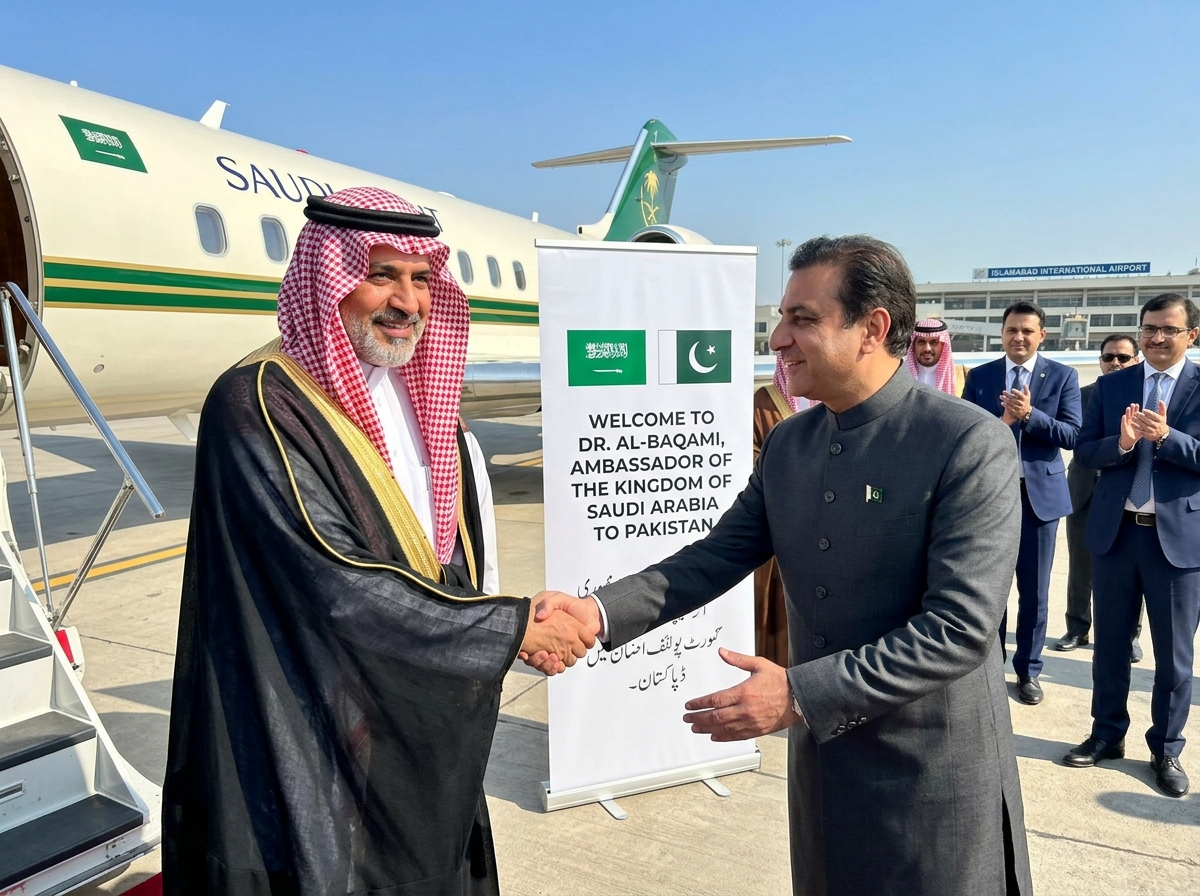
Saudi Arabia’s newly appointed ambassador to Pakistan, Dr Rajeh bin Tami Al-Baqami, arrived in Islamabad on Saturday to formally take up his post, the Royal Embassy of Saudi Arabia confirmed. His arrival comes as the two longstanding allies continue expanding cooperation across defence, investment and regional security.
Background
Pakistan and Saudi Arabia share a relationship stretching back nearly eight decades, built on religious, political and military ties. That partnership deepened further last year when the two countries signed a Strategic Mutual Defense Agreement on September 17, 2025, at Al-Yamamah Palace in Riyadh, under which any act of aggression against one nation would be treated as an act of aggression against both.
Al-Baqami’s posting follows the departure of Nawaf bin Said Al-Malki, who served as Saudi ambassador to Pakistan for nearly nine years. A retired rear admiral of the Royal Saudi Navy, Al-Malki oversaw a period of increased political engagement, deeper security cooperation and growing Saudi investment before being reassigned as the Kingdom’s ambassador to Algeria.
Details
Al-Baqami was received in Islamabad by Khushal Saeed, Assistant Director of the Protocol Department at Pakistan’s Ministry of Foreign Affairs, along with several members of the Saudi diplomatic mission’s staff. He was formally appointed to the post on July 29, one of eight new Saudi envoys who took the oath of office before Crown Prince Mohammed bin Salman that week.
A retired major general who later joined the Saudi Foreign Ministry, Al-Baqami holds a doctorate in Human Resource Management from Brunel University London. His arrival follows President Asif Ali Zardari’s farewell meeting with outgoing ambassador Al-Malki in late August, during which the president praised his contribution to strengthening bilateral ties.
The appointment also arrives against a backdrop of regional tension. Pakistan’s military has publicly reaffirmed its commitment to the defence pact with Saudi Arabia in recent weeks, following attacks on Saudi oil facilities linked to Iran-backed militias amid the wider regional fallout from the US-Iran conflict.
Quotes
Saudi Arabia’s Foreign Ministry described the broader diplomatic reshuffle in a statement, noting that the newly appointed ambassadors took their oath before the Crown Prince on behalf of the Custodian of the Two Holy Mosques. Pakistan’s military spokesperson, Lieutenant General Ahmed Sharif Chaudhry, separately stressed that Islamabad stands by its defence commitments to Riyadh, saying the two sides are “those people who stand by our agreements and promises.”
Impact
The ambassadorial transition reflects the broader trajectory of Pakistan-Saudi relations, which have moved beyond traditional religious and labour ties into a formal collective-security arrangement. Analysts note the relationship carries diplomatic weight for Saudi Arabia even though the Kingdom has limited capacity to offer direct military support to Pakistan in a regional conflict, with the value of the pact seen as largely symbolic and strategic rather than operational.
For Pakistan, continued Saudi investment and financial support remain significant, particularly as Islamabad works to stabilise its economy. The relationship has also drawn scrutiny from regional observers given Saudi Arabia’s simultaneous economic and military engagement with India, including joint exercises held in 2025.
Conclusion
Al-Baqami now begins his posting at a moment of heightened regional uncertainty, with both governments expected to maintain frequent high-level contact in the coming months. How the defence pact is operationalised in practice remains unclear, with Pakistani officials so far declining to detail its implementation, leaving that as a key point to watch as the relationship develops further.
Frequently Asked Questions
Who is Pakistan’s best friend country?
Pakistan does not have a single, formally designated “best friend” country, but two nations are most commonly cited in that context: China and Saudi Arabia. China is often referred to as Pakistan’s “all-weather friend” because of decades of close military, economic and diplomatic cooperation, including major infrastructure investment through the China-Pakistan Economic Corridor. Saudi Arabia, meanwhile, holds a distinct place rooted in religious ties, historical financial support during Pakistan’s economic crises, and now a formal defence pact signed in 2025. Which country is considered “closer” often depends on the specific area being discussed, whether that is military cooperation, trade volume, or diplomatic backing on international issues.
What is going on between Pakistan and Saudi Arabia?
Pakistan and Saudi Arabia are currently in a period of deepening strategic cooperation. The two countries signed a Strategic Mutual Defense Agreement in September 2025, formalising decades of informal security ties into a binding collective-defence commitment. Since then, the relationship has continued to develop through high-level visits, expanded investment pledges tied to Saudi Arabia’s Vision 2030 strategy, and the recent handover of the Saudi ambassadorship in Islamabad from Nawaf bin Said Al-Malki to Dr Rajeh bin Tami Al-Baqami. Pakistan has also publicly reaffirmed its commitment to the defence pact amid recent regional tensions involving Saudi oil facilities and Iran-backed militias.
Does Saudi Arabia have a military alliance with Pakistan?
Yes, in a formal sense since September 2025. The Strategic Mutual Defense Agreement signed that year states that an act of aggression against either Pakistan or Saudi Arabia will be treated as an act of aggression against both, a principle known as collective security. The pact builds on defence cooperation between the two countries dating back to the 1960s and includes expanded collaboration in areas such as military training, intelligence sharing and defence technology. However, the agreement does not explicitly address Pakistan’s nuclear arsenal, and officials have so far kept details of how it would be operationalised in an actual conflict largely undisclosed.
Leave a comment