

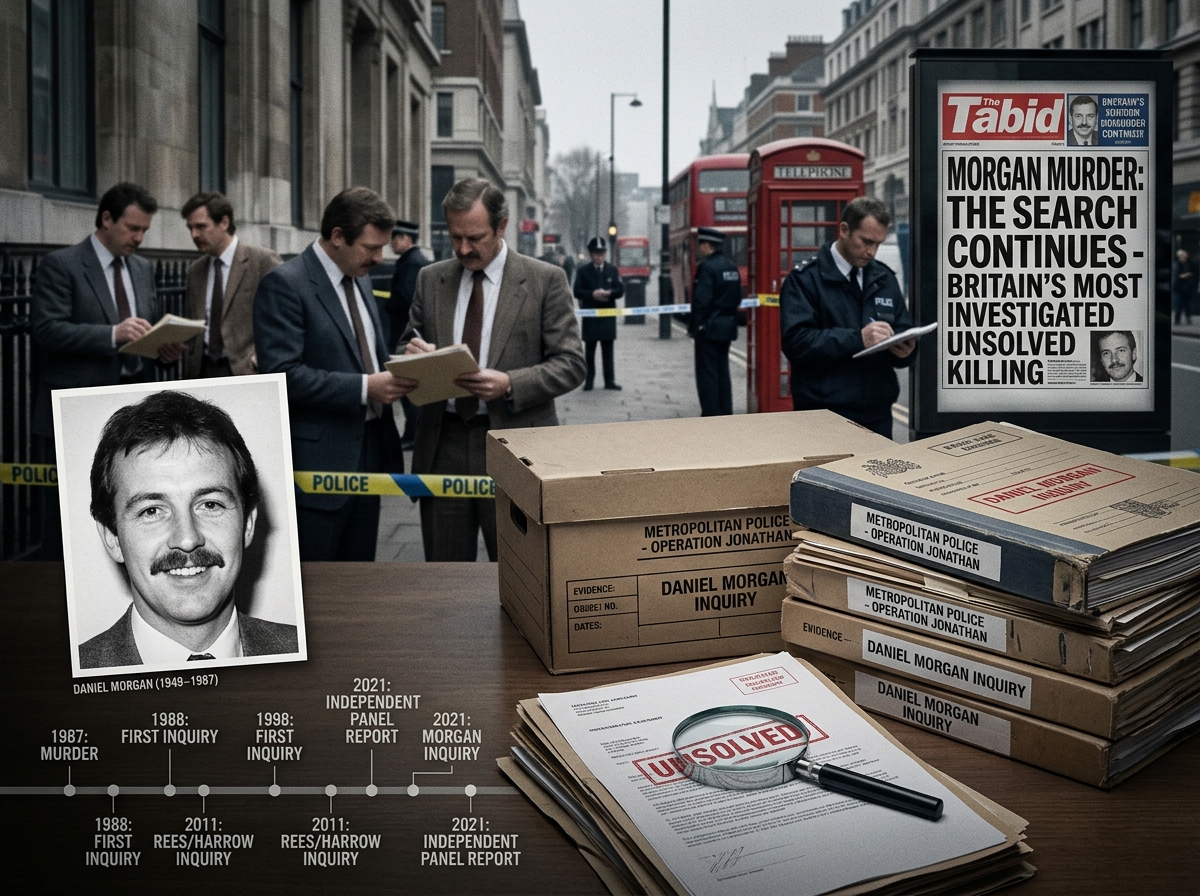
Daniel Morgan, a 37-year-old private investigator, was found murdered with an axe in a south London pub car park on 10 March 1987. Nearly four decades on, no one has ever been convicted, despite six police investigations and a landmark parliamentary inquiry that branded London’s Metropolitan Police “institutionally corrupt.”
Background
Morgan worked as a private investigator at a firm called Southern Investigations, based in south London. He was killed in the car park of the Golden Lion pub in Sydenham on the evening of 10 March 1987, struck in the head with an axe that was left in the wound. There were no witnesses to the attack.
At the time of his death, Morgan was reportedly preparing to sell a story to a newspaper about corruption involving police officers, some of whom had links to his own firm. That detail has shaped nearly every investigation and theory around the case ever since, feeding suspicion that his killing was connected to what he knew rather than a random act of violence.
Morgan’s business partner Jonathan Rees, former Metropolitan Police detective Sid Fillery, and Rees’ former brother-in-law Glenn Vian all came under sustained police scrutiny over the following decades. None were ever convicted. A 2011 trial against several suspects collapsed after prosecutors said flawed handling of the case by the Met made a fair trial impossible.
Details
Six separate police investigations were launched into Morgan’s death between 1987 and 2011, making it, by most accounts, the most investigated unsolved murder in Metropolitan Police history. Each inquiry uncovered fresh problems, ranging from lost evidence to allegations that officers had tipped off suspects.
In 2013, then Home Secretary Theresa May established the Daniel Morgan Independent Panel to examine how police corruption had affected the original investigation and how the Morgan family had been treated throughout the process. The panel, chaired by Baroness Nuala O’Loan, spent eight years reviewing evidence before publishing its final report in June 2021.
That report concluded that corruption played a significant role in the failure of the first investigation and accused the Met of a “form of institutional corruption” for its handling of the case in the years since, including what the panel described as attempts to protect the force’s reputation rather than confront its failings. The panel also found evidence of improper contact between corrupt officers and journalists at the now-defunct News of the World, tying the case into the wider phone-hacking scandal that engulfed the British tabloid press in the early 2010s.
Quotes
Baroness Nuala O’Loan, who chaired the Independent Panel, said the force’s overriding priority throughout much of the case had been to protect itself rather than confront its own failings. The Metropolitan Police responded to the report by acknowledging that corruption had been a major factor in the failings of the first investigation, while disputing the broader characterisation that it remains institutionally corrupt today.
Impact
The case has become a touchstone in British debates over police accountability and press ethics. Because the original inquiry was compromised by officers with personal ties to suspects, the Daniel Morgan case is frequently cited alongside the Stephen Lawrence Inquiry as evidence of deep, systemic problems inside the Met during the late twentieth century.
The Independent Panel’s findings also renewed calls for a full public inquiry into the relationship between police and the press, an issue that campaigners say was left unfinished when the second part of the Leveson Inquiry into press standards was shelved by the government in 2018.
Conclusion
More than 35 years after Morgan’s death, the case officially remains open, and the Metropolitan Police has said further forensic review work continues in the hope that advances in DNA technology could eventually identify those responsible. The Morgan family, led by his brother Alastair Morgan, has continued to campaign publicly for accountability, and the case remains a reference point whenever questions of police corruption resurface in the UK.
Frequently Asked Questions
Is the Daniel Morgan documentary on Netflix?
No. The main documentary series, Murder in the Car Park, is a Channel 4 production, not a Netflix original. It first aired on Channel 4 in June 2020 as a three-part series and is available to stream in the UK through Channel 4’s on-demand service, All4. Viewers outside the UK searching for it on Netflix will not currently find it there, since international streaming rights for the series sit with different platforms depending on the region, so it is worth checking your local Channel 4 or All4-equivalent service first.
Is there a Daniel Morgan podcast?
The case has been covered extensively across true crime and investigative journalism podcasts over the years, often in connection with coverage of the phone-hacking scandal and the Daniel Morgan Independent Panel’s findings, given how closely the two stories are linked. There is no single official podcast tied directly to the Channel 4 series itself, so listeners are best served searching current podcast platforms for recent episodes, since coverage has continued to appear periodically as new developments in the case emerge.
Where can I watch Murder in the Car Park?
Murder in the Car Park is available to stream on Channel 4’s All4 platform in the UK. The three-part series first broadcast weekly from 15 June 2020, with a total running time of around 170 minutes across all episodes. It combines dramatised reconstructions, archive footage, and interviews with key figures from the case, including Daniel Morgan’s brother Alastair and some of the men who were investigated over the killing.
Leave a comment