

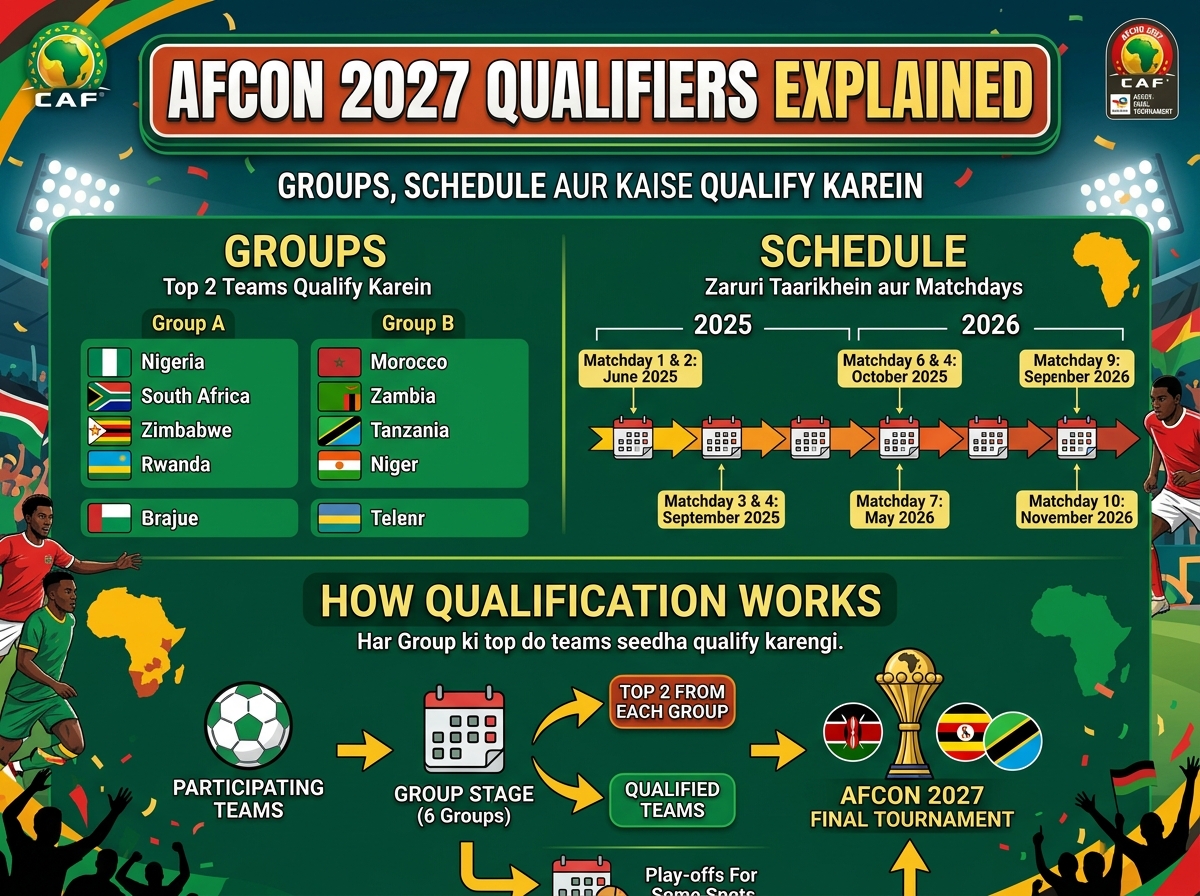
The AFCON 2027 qualifiers are officially underway, marking the start of a long campaign that will decide which 24 nations travel to Kenya, Tanzania and Uganda next summer. The tournament, branded the TotalEnergies CAF AFCON PAMOJA 2027, will be the first Africa Cup of Nations staged jointly by three host countries.
With 48 teams chasing places and a qualifying format spread across three separate international windows, fans have plenty to track between now and March 2027. Here is a complete breakdown of how the process works.
Background: From Preliminary Round to Group Stage
Qualification for AFCON 2027 began earlier this year with a preliminary round involving the twelve lowest-ranked participating nations. Those sides played home-and-away ties, with the six winners advancing to join the 42 teams that entered qualifying directly, producing a 48-team main draw.
CAF then split the 48 nations into twelve groups of four. Each team plays six matches in its group, three at home and three away, facing every rival in the section twice before the campaign concludes. There are no knockout rounds once the group stage ends; final standings alone determine who advances.
Details: Format, Host Nations and the Matchday Calendar
The qualifying format includes a built-in twist because of the tournament’s unusual hosting arrangement. Kenya, Tanzania and Uganda are each guaranteed a place at AFCON 2027 as co-hosts, and they sit in Groups D, H and L respectively. Since their qualification is already secured, only the best-placed team among the other three nations in each of those three groups will earn a spot at the finals.
Across the remaining nine groups, the top two teams progress in the conventional manner. Combined with the three automatic co-host qualifiers, this produces the full 24-team field for next summer’s tournament.
The six matchdays are being played across three separate FIFA international windows rather than in one continuous block. Matchdays one and two run from 21 September to 6 October 2026, matchdays three and four follow between 9 and 17 November 2026, and the qualifying campaign wraps up with matchdays five and six from 22 to 30 March 2027.
Matchday one alone features 24 fixtures played between 24 and 26 September, including headline clashes such as Ivory Coast against Ghana in Group C, Morocco hosting Gabon, Egypt facing Angola, and Algeria taking on Zambia. Co-host nations Kenya, Tanzania and Uganda will still play every qualifying fixture, using the matches as competitive preparation even though their tournament places are already confirmed.
Quotes and Analysis From Around the Continent
Coverage of the opening rounds has highlighted just how much turnover African football has seen since the last major qualifying cycle. Only a handful of coaches who were in charge of their national teams during 2026 World Cup qualifying remain in their posts, reflecting the pressure federations place on results even during rebuilding phases.
Commentators following Group C have pointed to Ivory Coast and Ghana as the section to watch most closely, given both nations’ history of continental success and their contrasting circumstances heading into the campaign: Ivory Coast rebuilding under a returning championship-winning coach, and Ghana adjusting to new leadership after missing out on the 2025 tournament entirely.
Impact: Why These Qualifiers Matter
For established football nations, the qualifiers are as much about squad-building as results. Coaches such as Carlos Queiroz in Ghana andsiman Pitso Moe in South Africa are using the opening matchdays to test new-look squads ahead of a demanding campaign, blending experienced professionals with fresh call-ups.
For the co-host nations, the qualifiers offer a different kind of value. Although their finals places are locked in, competitive fixtures against genuine opposition give coaching staff in Kenya, Tanzania and Uganda valuable match practice before they carry the weight of hosting the tournament in front of home supporters.
The wider qualifying picture also matters for smaller footballing nations. Countries such as Gambia, Comoros and Cape Verde, who have made surprise appearances at recent Africa Cup of Nations tournaments, will again look to use the group stage to upset more established rivals and claim one of the limited qualifying places.
Conclusion: What to Watch Next
With matchday one now underway, attention turns quickly to matchday two, which runs through early October before the qualifiers pause until the November international window. The March 2027 matches will ultimately decide the final make-up of the 24-team tournament.
As the qualifying campaign develops, expect shifting group tables, coaching changes at underperforming federations, and growing anticipation for a tournament that will bring the Africa Cup of Nations back to East Africa for the first time in five decades.
Frequently Asked Questions
How many teams qualify for the AFCON 2027 finals from each group? In nine of the twelve groups, the top two teams qualify in the usual way. In the three groups containing a co-host nation, only the highest-placed of the remaining three teams also qualifies, since the host’s place is already guaranteed.
Where can fans follow the AFCON 2027 qualifiers table? Group standings are updated by CAF after each round of fixtures and are also tracked by major football statistics platforms, with the picture becoming clearer after every completed international window.
How many teams qualify for the 2026 World Cup from Africa? African World Cup qualification runs on a separate schedule to the AFCON qualifiers and is determined by CONMEBOL and FIFA’s continental allocation rules rather than the Africa Cup of Nations qualifying process covered here.
Leave a comment