

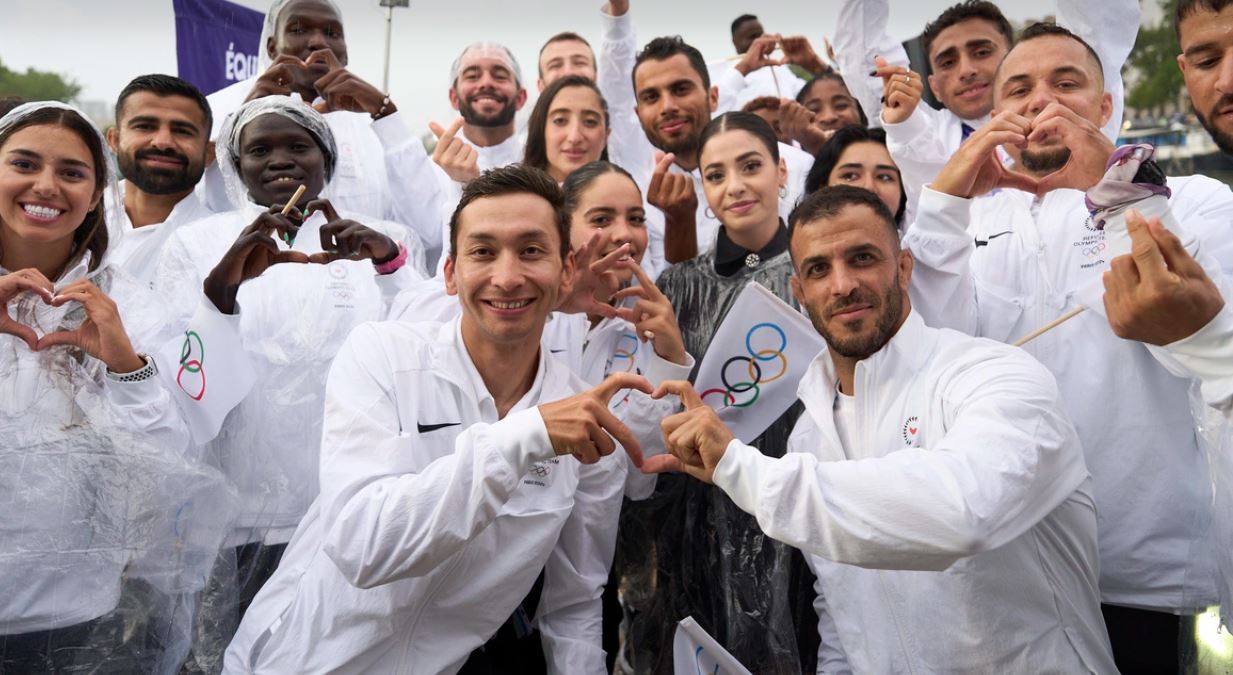
The Refugee Olympic Team has become one of the more unusual fixtures of modern sport a squad with no country, no anthem, and no flag of its own, made up entirely of athletes who fled war or persecution. A decade after it first marched into an Olympic stadium, the idea has spread beyond the Olympics itself, with two Syrian athletes now representing a newly formed refugee delegation at the Asian Games.
Background: Where the Idea Came From
The team was announced by the International Olympic Committee in March 2016, months before the Rio Games, as a response to the scale of the global migrant crisis at the time. IOC President Thomas Bach framed it as a symbol of hope for people who had lost their homes and their national identity along with them.
Ten athletes made up that first squad in Rio swimmers, judokas, and middle-distance runners from Syria, South Sudan, Ethiopia, and the Democratic Republic of the Congo. They marched under the Olympic flag, just ahead of host nation Brazil, and competed with no national anthem to call their own.
In September 2017, the IOC set up the Olympic Refuge Foundation to keep supporting displaced athletes long after that first Games ended, turning what could have been a one-off gesture into an ongoing program.
Details: How the Team Has Grown Since Rio
The numbers tell part of the story. Ten athletes competed in 2016, rising to 29 at the Tokyo Games in 2021, and reaching 37 at Paris 2024, the largest squad yet. Athletes have come from countries including Afghanistan, Iran, Iraq, Cameroon, Eritrea, Sudan, Venezuela, and Syria, training and competing under the IOC code EOR, short for the French name Équipe Olympique des Réfugiés.
One gap remains, though. No refugee athlete has ever competed at a Winter Olympics, including this year’s Milano-Cortina Games, and none has competed at a Youth Olympics either, summer or winter. So far, it’s stayed a summer-only story.
That’s part of what makes the latest development notable. The Olympic Council of Asia has now formed its own refugee delegation for the 20th Asian Games, running from September 19 to October 4 in Aichi-Nagoya, Japan. Two athletes will compete in taekwondo under the name Olympic Council of Asia Refugee Team, walking in the opening and closing ceremonies behind the OCA flag rather than any national one.
Quotes: What Officials and Athletes Have Said
UNHCR High Commissioner Filippo Grandi spoke about the Tokyo squad in terms that still apply to every edition since. He said that surviving war, persecution, and the anxiety of exile already makes these athletes extraordinary, and that seeing them also excel on the world stage fills him with pride.
Athletes themselves tend to describe the team in more personal terms. Syrian judoka Muna Dahouk, who competed in Paris, has spoken about her father coaching her through judo as a child in Syria, long before either of them imagined she’d represent refugees at an Olympic Games. Runner Paulo Amotun Lokoro, part of the original 2016 squad, said simply that raising the refugee flag meant showing people still in the camps that leaving is possible.
Impact: More Than a Symbolic Gesture
The team has picked up real recognition beyond the Games themselves. In 2022, it won the Princess of Asturias Award for Sport, recognising the opportunities it creates for athletes from conflict zones and places where basic rights are routinely violated.
It’s also produced an actual medal now. Cameroonian-British boxer Cindy Ngamba won bronze at Paris 2024, the team’s first medal in its history. One bronze puts the Refugee Olympic Team at 151st on the all-time medal table, which sounds low until you remember it’s a squad that didn’t exist a decade ago.
The Asian Games version of this idea matters for a similar reason. It signals that regional sporting bodies, not just the IOC, now see displaced athletes as a group worth building permanent pathways for, rather than a one-time Olympic gesture.
Conclusion: What Comes Next
The next real test for the program is whether it finally reaches the Winter Games, an obvious gap given how many displaced people come from regions with no winter sports infrastructure to train in. Whether that changes by the next Winter Olympics remains an open question.
In the nearer term, the two-athlete taekwondo team competing at Aichi-Nagoya in the coming weeks will be watched closely as a test case for how far the Asian Games version of this idea can go, and whether it grows the way the Olympic team did after its own modest start in Rio.
FAQs
Who were the members of the 2016 Olympic swimming refugee team?
The 2016 Rio squad included two Syrian swimmers, Yusra Mardini and Rami Anis, alongside eight other athletes competing in judo and athletics. Mardini’s story drew the most attention at the time she and her sister Sara had swum for hours in open water to help push an overcrowded dinghy carrying other refugees to safety during their own crossing from Turkey to Greece in 2015. That story later became the basis for the 2022 Netflix film “The Swimmers.” Anis, who trained in Belgium after fleeing Aleppo, competed in the 100m butterfly.
Is Sara Mardini free now?
Yes. Sara Mardini, Yusra’s older sister, was arrested in Greece in 2018 and spent around three months in prison over her volunteer work rescuing migrants at sea with the NGO Emergency Response Centre International. She faced two rounds of prosecution over the following years, first acquitted in a 2023 case involving charges that included espionage, then acquitted again in January 2026 alongside 23 other aid workers on charges of migrant trafficking and forming a criminal organisation. The presiding judge ruled their actions amounted to humanitarian aid, not criminal activity, closing out a legal fight that human rights groups had criticised for years.
Who are the top 10 swimmers in the world?
There’s no single fixed list, since rankings are broken down by stroke and distance and shift after every major meet. Someone who tops the 100m freestyle rankings might not even feature in the top 20 for backstroke. World Aquatics keeps official event-by-event rankings on its site, and that’s a better source to check than any “top 10” list, because those go stale fast once a new World Championships or Olympics rolls around.
Leave a comment