

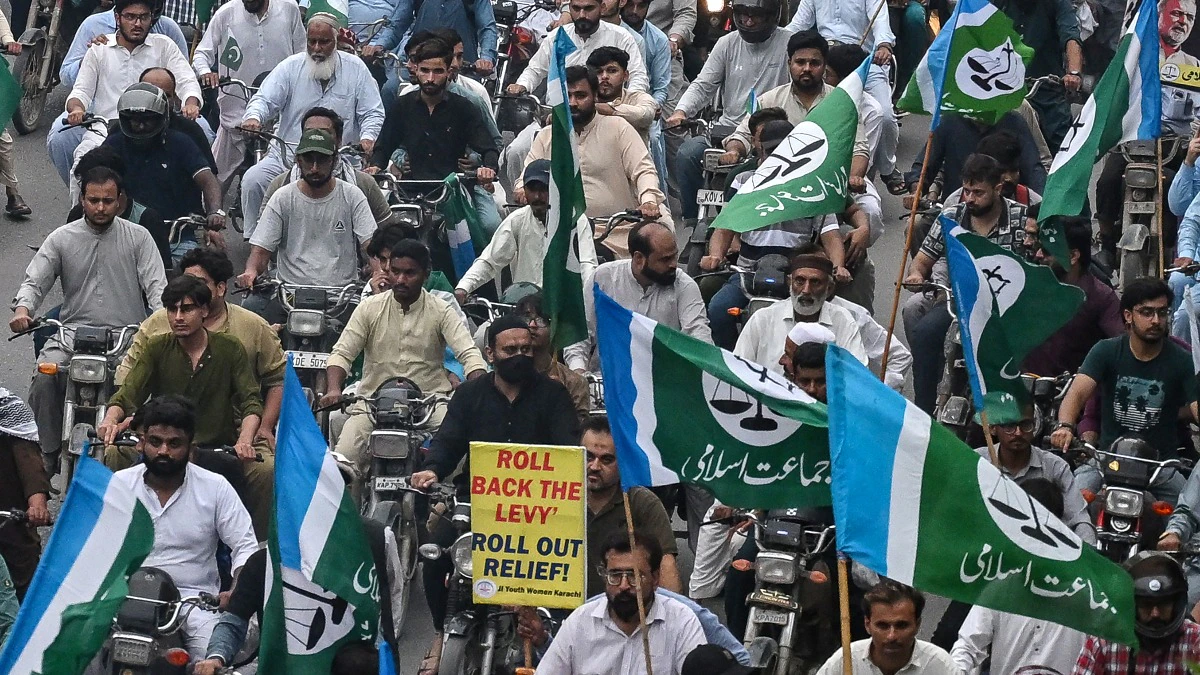
Jamaat-e-Islami Pakistan has pushed ahead with its long-threatened march on Islamabad, with party Ameer Hafiz Naeemur Rehman leading supporters toward the federal capital to demand the government scrap the petroleum levy entirely. The march follows weeks of sit-ins, strikes, and warnings that didn’t get the government to budge.
The immediate trigger is money, not ideology. JI says the levy has let the government pull in trillions of rupees from ordinary fuel buyers, many of whom don’t even fall into the regular tax net, while relief measures announced by the prime minister barely make a dent.
Background: How We Got Here
This didn’t come out of nowhere. JI’s campaign against the petroleum levy has been building since late July, when the party’s local chapters in Peshawar, Karachi, and Rawalpindi started holding smaller protests and press conferences over rising fuel prices.
By early August, JI had escalated to blocking highways in Khyber Pakhtunkhwa and organizing a women’s wing demonstration in Karachi. The party set August 7 as a national protest day, then followed it with sit-ins in Lahore, Karachi, and Peshawar that stretched on for over a week. A shutter-down strike came next, and when that still didn’t move the government, JI announced the long march itself, setting September 20 as the date.
What’s Actually Happening Now
Thousands of JI workers and supporters are converging on Islamabad from multiple cities, with the party insisting it won’t be stopped by shipping containers or roadblocks the way past marches have been. Hafiz Naeem told supporters in Gujranwala ahead of the march that the government could place as many containers as it wanted, but protesters would clear them and reach the capital anyway.
The party’s core demand hasn’t changed since July: abolish the petroleum levy completely. JI has also folded in a second demand, ending what it calls favorable agreements with independent power producers, arguing a forensic audit would expose who benefited from those deals.
Quotes From JI Leadership
Hafiz Naeem has been blunt in his public remarks leading up to the march, calling the levy a “goon tax” and accusing the government of hiding behind IMF conditions instead of taking responsibility. He’s repeatedly tied the fuel price issue to broader complaints about government spending, pointing to official travel and expenses as examples of double standards.
“Our clear message is: abolish the levy or there will be a march on Islamabad,” Liaquat Baloch said, summarizing the party’s position after talks with the government team collapsed.
Government officials, for their part, have maintained that the levy is tied to IMF-linked fiscal commitments and can’t simply be scrapped without consequences for Pakistan’s broader financial arrangements, though JI has rejected that explanation as an excuse.
Impact: What This Means for Pakistan
Two big opposition-aligned marches hitting Islamabad around the same stretch JI’s and PTI’s puts real pressure on a government that’s already juggling several political fights at once. How authorities handle it will say a lot about what residents and businesses in Islamabad and Rawalpindi are in for over the next few days.
The petroleum levy itself touches almost everyone financially, since fuel costs feed straight into transport fares, food prices, and household budgets across the board. Whether JI actually forces a policy change or not, the sheer size of the frustration behind this campaign is something the government can’t just wait out.
Conclusion: What Comes Next
The march’s outcome now depends largely on how the government responds once protesters actually reach Islamabad, whether that means further negotiations, some kind of partial concession, or an attempt to contain the demonstration. JI has signaled it’s prepared to escalate further if the levy isn’t abolished, which suggests this isn’t likely to be the final round of pressure even if this particular march winds down peacefully.
FAQs
Is there Jamaat-e-Islami in Pakistan?
Yes it’s one of the country’s oldest and most organized religious-political parties, with chapters across every province and a long track record in national politics, welfare work, and student activism through its affiliated wings. Hafiz Naeemur Rehman has led the party since 2024, and JI keeps an active presence at both the national and local level, including women’s and youth wings that show up consistently in campaigns like this petroleum levy protest.
What is Jamaat-e-Islami Pakistan’s ideology?
JI positions itself as an Islamic revivalist movement pushing for governance based on Islamic principles, and it’s long been critical of what it sees as secular, Western-influenced economic policy. In practice that translates into opposition to IMF-linked austerity measures, calls for heavier social welfare spending, and steady anti-corruption rhetoric aimed at both military and civilian leadership. The party’s also known for strong grassroots organizing, which is part of why campaigns like this one tend to pull large, sustained crowds rather than fizzling out after a day or two.
Who is the founder of Jamaat-e-Islami?
The party was founded in 1941 by Sayyid Abul Ala Maududi, an Islamic scholar whose writing on Islamic governance still gets cited well beyond Pakistan. After the 1947 partition, the original organization split into two Jamaat-e-Islami Pakistan and Jamaat-e-Islami Hind which now run independently in their own countries, even though they trace back to the same founder and ideological base.
Leave a comment