

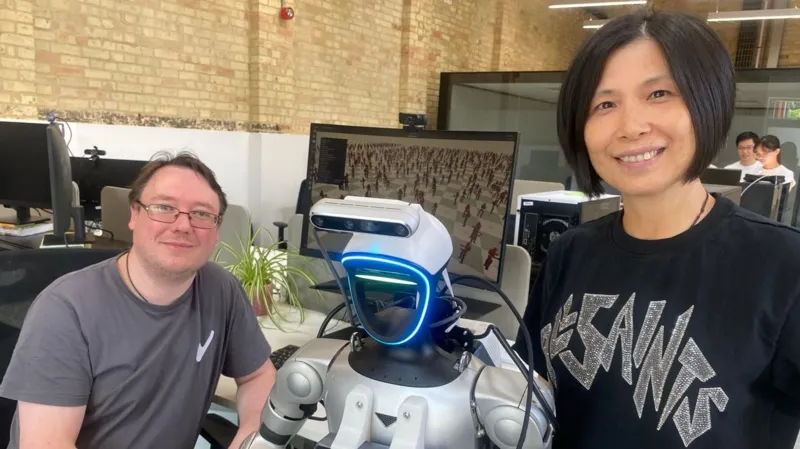
Freddo Robot demonstrates how virtual AI training can help humanoid machines learn real-world tasks in minutes rather than days.
A British technology startup is developing software designed to help robots learn practical tasks faster, with Freddo the robot demonstrating how quickly artificial intelligence can transfer skills from virtual simulations to physical machines.
During a demonstration at Cambridge-based startup Vsim, Freddo walked across an office, recognized a plastic bottle offered by a staff member and successfully grasped it.
While the task may appear simple, the speed at which the robot learned the sequence is significant. Developers say Freddo was trained to perform the task in just a few minutes, while competing systems can reportedly take considerably longer to develop similar capabilities.
Freddo Robot Trained Through Virtual Simulations
Freddo’s abilities were developed in a virtual environment, where robotic tasks can be simulated repeatedly on computers.
Instead of requiring the physical robot to practice millions of times, the software can perform a task in simulation at extremely high speed.
The system searches for an optimal solution, known as a policy, which can then be transferred to the physical robot.
This approach could potentially reduce the time required to train robots to perform everyday tasks.
British Startup Vsim Develops Robot Training Technology
The demonstration took place at Vsim, a British startup based in Cambridge.
Founders Michelle Lu and Kier Storey hope their software can eventually control robots capable of navigating homes and workplaces while performing useful tasks.
However, the technology remains at an early stage, and significant challenges remain before robots can reliably perform complex everyday activities without human assistance.
Storey explained that robotics presents an unusual challenge because tasks that appear extremely difficult for humans, such as gymnastics, can sometimes be performed effectively by robots.
At the same time, relatively ordinary human abilities such as fine dexterity and manipulating objects remain difficult for machines.
The ability to train robots in simulated environments could become an important part of the development of advanced robotics.
A virtual environment allows developers to expose robots to large numbers of scenarios without repeatedly risking damage to expensive physical hardware.
Once a successful behavior has been identified, the resulting policy can be transferred to a physical robot such as Freddo.
The technology could eventually be used for robots designed to carry out tasks in homes, offices, factories and other working environments.
However, robots still need to overcome challenges involving perception, movement, dexterity, safety and adapting to unpredictable real-world situations.
Freddo’s demonstration illustrates the growing connection between AI simulation and physical robotics.
Rather than manually programming every individual movement, developers can use simulations to allow AI systems to discover effective ways of completing tasks.
The key challenge is ensuring that skills developed in a simulated environment work reliably when transferred to the real world.
For Vsim, the long-term goal is to make that process faster and more effective, potentially allowing robots to learn useful skills in dramatically less time.
Leave a comment