

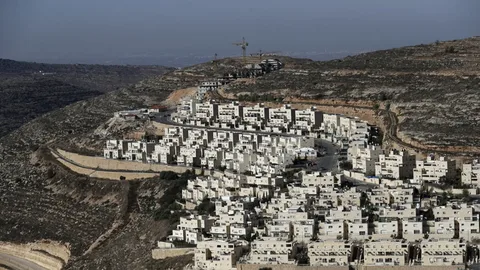
Israel has issued a tender for 2,167 housing units as part of its long-stalled E1 settlement plan in the occupied West Bank, according to Israeli rights groups tracking the project. The move completes the government’s rollout of a 3,401-unit settlement that critics say would cut the West Bank in two.
Summary
The tender covers land between Jerusalem and the Ma’ale Adumim settlement bloc. It follows an earlier tender for 1,234 units opened in August 2026, bringing the total number of housing units now up for bidding to the full 3,401 approved for the E1 zone. Bidding is set to open on October 25, just two days ahead of Israel’s parliamentary election.
Background
E1 is not a new idea. Israeli governments have floated building in this 12-square-kilometer stretch of land for close to three decades, only to shelve it each time under pressure from Washington and European capitals. The plan resurfaced in 2025, when it received final government approval, and has moved forward in stages since.
What makes E1 different from most West Bank settlement projects is geography. The land sits directly east of Jerusalem, wedged between the city and Ma’ale Adumim. Building here would link that settlement bloc to East Jerusalem while cutting off the northern and southern halves of the West Bank from one another.
Palestinian officials have long viewed East Jerusalem as the capital of a future state. Fragmenting the territory this way, critics argue, would make that state difficult to sustain on a map, let alone govern.
Details
Israeli rights group Ir Amim said in a statement that the newly issued tender for 2,167 units is separate from, and additional to, the 1,234-unit tender opened on August 18. Together, the two tenders account for all 3,401 housing units approved for E1 in 2025.
According to reporting from the Wall and Settlement Resistance Commission, the original December 2025 tender had grouped all 3,401 units into one package before authorities split it into two rounds. Bids on the newer tender are due by October 25, with a final submission deadline in December.
Rights groups have flagged the bidding date itself as significant. It falls just before Israel’s scheduled parliamentary election on October 27, a timing Ir Amim said points to a deliberate effort to lock in construction contracts before any change in government.
The E1 project also includes plans for hotels, roads, and industrial zones, alongside the residential units. Human Rights Watch has said the broader development would displace Bedouin communities currently living on the land.
Quotes
Ir Amim said the October bidding date shows the government intends to “create an increasingly irreversible reality on the ground” ahead of the election. Israeli Finance Minister Bezalel Smotrich, an ultra-nationalist figure in the ruling coalition, has said the E1 project would “bury” the idea of a Palestinian state.
A representative for Palestinian President Mahmoud Abbas condemned the latest tender, arguing that the E1 development violates international law. The Israeli Prime Minister’s Office did not respond to requests for comment on the tender.Peace Now, an Israeli settlement watchdog, has separately described the government’s rush to finalize E1 contracts before the election as an attempt to make the project harder for a future administration to cancel.
Impact
The reaction abroad has been swift and largely critical. The United Kingdom summoned Israel’s ambassador over an earlier E1 tender, with Foreign Secretary Ed Miliband calling the settlement push an unacceptable and destructive act. France has said the plan runs counter to international law and threatens any realistic path to a two-state solution. The European Union has issued similar warnings, tying E1 to broader concerns about settler violence and the fragmentation of Palestinian territory.
Israeli settlements in the West Bank are widely regarded as illegal under international law, a position most of the international community has held for decades, though Israel disputes this characterization. The E1 project has drawn unusually sharp pushback even by that standard, largely because of what it would do to the geography of a future Palestinian state rather than simply adding another settlement to the map.
Legal challenges are still pending before Israeli courts, brought by groups including Peace Now, Bimkom, and Ir Amim on behalf of Bedouin residents in the area. None of those challenges has stopped the tenders from moving forward so far.
Conclusion
With both tenders now open, all 3,401 approved E1 housing units are formally in the bidding process, and construction could begin once contracts are signed after the October elections. Whether that happens will depend partly on the outcome of the vote and partly on whether pending legal challenges gain any traction before bids close in December. For now, rights groups and Western governments are watching the October 25 bidding date closely, since it lands just before Israelis go to the polls.
Frequently Asked Questions
Is Israel trying to expand its territory?
Israel has not formally annexed the West Bank, but settlement construction there has expanded steadily for decades despite international objections. Projects like E1 extend Israeli-built infrastructure and housing deep into land Palestinians and most of the international community consider part of a future Palestinian state, which is why critics describe settlement growth as a form of de facto territorial expansion even without a formal annexation declaration.
What are Israeli settlements?
Israeli settlements are communities built by Israel in territory occupied during the 1967 Six-Day War, primarily the West Bank and East Jerusalem. They range from small outposts to full towns with tens of thousands of residents. The United Nations and most governments consider them illegal under international humanitarian law, specifically the Fourth Geneva Convention’s rules on an occupying power transferring its population into occupied territory, though Israel disputes this legal interpretation and cites historical and security justifications for the settlements.
Has Israel ever expanded its territory?
Yes. Israel annexed East Jerusalem and the Golan Heights after the 1967 war, moves that are not recognized by most of the international community. The West Bank remains under Israeli military occupation rather than formal annexation, but settlement expansion there, including projects like E1, has steadily increased the footprint of Israeli-controlled land and infrastructure within the territory over time.
Leave a comment