
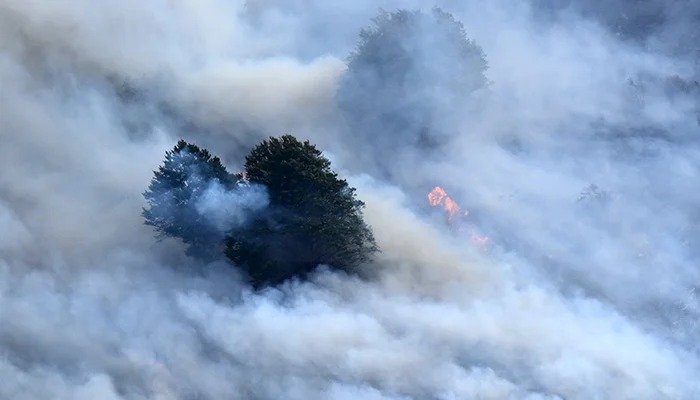

GENEVA: Rising wildfires and heatwaves are threatening global efforts to improve air quality and protect human health, as toxic microscopic pollutants from fires increasingly contaminate the atmosphere, the World Meteorological Organization (WMO) warned Monday.
The United Nations weather and climate agency highlighted the growing connection between air pollution and climate change, saying rising temperatures are contributing to more frequent and intense heatwaves and wildfires.
“Extreme wildfires are increasing, leading to big health consequences because of the high toxicity of smoke,” the WMO said in its latest annual Air Quality and Climate Bulletin.
The agency noted that while regulations in Europe and North America have helped reduce PM2.5 emissions from industry and transport, exposure to wildfire-related PM2.5 pollution has increased.
Wildfire smoke poses serious health risks
PM2.5 refers to microscopic particles and droplets measuring less than 2.5 micrometres in diameter. These pollutants are particularly dangerous because they can travel deep into the lungs and enter the bloodstream.
PM2.5 can come from a range of sources, including fossil-fuel-powered industries, agriculture, household heating and transportation. Wildfires and dust storms are also major sources of airborne particulate pollution.
The WMO warned that the increasing frequency and intensity of extreme wildfires could undermine progress made through air-quality regulations.
Lorenzo Labrador of the WMO’s Global Atmosphere Watch network told AFP that air quality and climate change cannot be treated as separate issues.
“Air quality and climate change can’t be dealt with separately. If one worsens, the other does too,” Labrador said.
According to Labrador, areas affected by powerful forest fires can experience high concentrations of fine-particle pollution.
He said microscopic particles produced by burning vegetation can be more toxic than particles from several other pollution sources, including car exhaust.
Wildfire smoke contains a complex mixture of gases and particles that can travel significant distances, potentially affecting communities far from the original fire.
The health risks are particularly concerning for people exposed to high concentrations of smoke over extended periods.
The WMO said governments and environmental agencies need to improve monitoring of airborne pollutants, including aerosols, black carbon, microplastics, fine particles and ground-level ozone.
The agency warned that some of these pollutants are not sufficiently monitored despite being widespread and potentially harmful to ecosystems.
Better monitoring could help authorities understand how climate-related events such as wildfires and heatwaves affect air quality and public health.
The WMO called for coordinated policies on climate change and air quality, arguing that the two challenges need to be addressed together.
As global temperatures rise, the risk of extreme heat and severe wildfires can increase, while the resulting smoke can worsen air pollution.
The agency stressed that tackling emissions from human activities remains important, but policymakers must also account for pollution generated by climate-related events.
The latest warning underscores the growing challenge facing countries seeking to improve air quality while dealing with the impacts of a warming climate.