
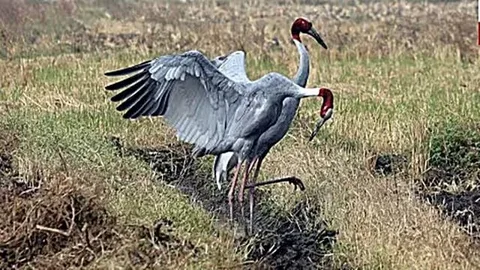

Khyber Pakhtunkhwa’s wildlife department has opened a live-capture season for Sarus cranes, running from September 1 to October 15. The move sets fixed quotas on how many birds can be taken, but it’s already drawing renewed attention from conservationists who’ve flagged the province’s crane hunting for years.
Background: A Province Known for Crane Capture
Sarus cranes migrate through parts of Khyber Pakhtunkhwa each year, and communities in districts like Lakki Marwat have a long tradition of catching them alive rather than shooting them, often keeping the birds afterward. Wildlife conservationists have said for years that Khyber Pakhtunkhwa tops the list of provinces where this happens at scale, ahead of Balochistan and Punjab.
The Sarus crane is recognized as the world’s tallest flying bird, known for its height, long legs, and distinctive reddish head. That distinctiveness is part of why the bird has long been a target for capture rather than casual hunting, since captured cranes often end up kept as prized possessions in homes and courtyards across the region.
Details: What the New Rules Actually Allow
Under this year’s rules, the wildlife department has set aside a quota of 100 camps spread across different districts of the province. Each of those camps is allowed to catch a maximum of 15 Sarus cranes over the roughly six-week season.
Camp operators aren’t permitted to catch any other bird species while the Sarus season is open, a restriction meant to keep the permit narrowly focused on this one species rather than opening the door to broader hunting. The department has also barred capture entirely in certain specified areas, though it hasn’t yet released a public list of exactly where those protected zones are.
The Conservation Angle
Earlier this year, Khyber Pakhtunkhwa’s provincial cabinet approved a memorandum of understanding between the wildlife department and the International Crane Foundation, aimed at strengthening crane conservation and habitat protection in the province. Officials described the partnership as a way to bring in scientific research, improve enforcement against wildlife crime, and support local communities through eco-tourism rather than capture alone.
That partnership makes for an odd pairing with this year’s call to reopen a capture season at all, quota or not. Conservationists have argued for a while now that even limited, permitted capture adds pressure on populations that are already vulnerable across their migratory range through South Asia.
Impact: A Tension Between Tradition and Protection
For rural communities along the migration route, crane capture is tied to income and long-standing local practice, which makes an outright ban politically difficult even where conservation concerns are real. The quota system is essentially a middle path, allowing the practice to continue in a regulated form rather than trying to eliminate it outright.
Regionally, Pakistan’s approach to Sarus cranes gets watched closely because the species crosses international boundaries during migration, meaning population pressure in one country affects numbers seen elsewhere along the flyway. How well this season’s rules are actually enforced, particularly the ban on capture in restricted zones, will likely shape how conservation groups view the province’s commitment going forward.
Conclusion: What to Watch Next
With the season running until mid-October, the real test will be whether the 100-camp, 15-bird-per-camp limit holds up in practice or gets exceeded in areas with weaker enforcement. The new tie-up with the International Crane Foundation gives outside conservation experts more visibility into the province’s crane population, which could shape how future seasons are structured. Whether that partnership leads to tighter rules next year, or simply better data on how the current ones are working, remains to be seen.
FAQs
What is a crane bird?
Cranes are large, long-legged, long-necked birds found across wetlands, grasslands, and river plains on most continents except South America and Antarctica. There are around 15 species worldwide, ranging from the Sarus crane featured in this story to species like the Common Crane and Demoiselle Crane that also pass through parts of Pakistan during migration. They’re known for their elegant build, loud calls that can travel long distances, and elaborate courtship dances that involve jumping, bowing, and wing-flapping between paired birds.
What does a crane eat?
Cranes are largely omnivorous, feeding on a mix of grains, seeds, roots, and tubers alongside insects, small fish, frogs, and other small animals they find in wetlands and farmland. Their diet shifts with the seasons and with what’s locally available, which is part of why cranes are often seen foraging in agricultural fields alongside natural wetland habitats. This adaptability helps them survive across a wide range of climates, though it also puts them in regular contact with farming communities, for better or worse.
What is special about a crane?
Cranes are often singled out for their size, their loyalty, and their striking courtship displays. Many species mate for life and perform synchronized dancing rituals involving bowing, leaping, and calling in unison, behavior that’s made cranes culturally significant in numerous societies as symbols of fidelity and longevity. The Sarus crane specifically holds the title of the world’s tallest flying bird, standing well over five feet, which makes it especially conspicuous, and unfortunately, an especially easy target for capture.