
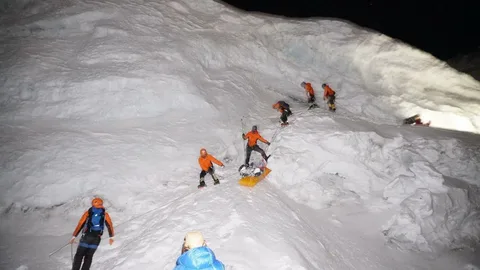

A ground rescue team has recovered the body of Pakistani climber Dr Asma Mushtaq from Gilgit-Baltistan’s Spantik peak. The recovery came almost ten days after she died during a high-altitude Spantik expedition on August 20. Her body was found near Camp 3, at an altitude of roughly 6,250 metres.
Background
Spantik, also called Golden Peak, rises 7,027 metres in the Karakoram range. It is one of the most attempted 7,000-metre peaks in Pakistan because its main route is technically manageable for climbers building experience toward 8,000-metre mountains. Dr Mushtaq was part of a five-member Pakistani women’s expedition team that included fellow climbers Zoni Aslam, Zaba Shigri, Shama and Sohana.
She had reached the 7,027-metre summit successfully and was reported to be in good health at that point. Complications began only during her descent, when she suffered a serious high-altitude medical emergency.
Details
According to the Alpine Club of Pakistan (ACP), Dr Mushtaq developed the emergency at around 6,400 metres while descending the mountain. Her mountain guide Akbar Ali, along with another guide, stepped in to help her immediately. Despite this assistance, she died on the mountain on August 20.
What followed was a prolonged and difficult recovery operation. The mission to bring her body down was coordinated by her expedition company alongside the Tourism Department, the local government, and the ACP, with climbers from multiple teams joining the effort.
Recovery attempts were repeatedly disrupted by extreme weather on the mountain. At one stage, rescuers reached the suspected location of the body only to find it buried under fresh snowfall, which made the search significantly harder. Heavy snow and strong winds near Camp 3 forced teams to turn back on more than one occasion, and helicopter support could not be used during the worst of the weather.
A five-member team of high-altitude mountaineers from Shigar eventually launched a fresh recovery attempt after earlier missions had failed because of the heavy snowfall. Working under difficult terrain conditions, this team succeeded in locating and recovering Dr Mushtaq’s body. It was found near Camp 3, at approximately 6,250 metres, and was expected to be moved down to Camp 2 ahead of a planned airlift by Pakistan Army helicopters.
Quotes
ACP Secretary General Ayaz Shigri confirmed the recovery details, including the exact location and altitude at which the body was found. Federal Information Minister Attaullah Tarar had earlier posted regular updates on the operation, at one point noting that the rescue team was moving carefully and would continue as weather permitted. The ACP also confirmed that the circumstances surrounding her death, along with the conduct of the expedition company involved, would be reviewed once the recovery was complete.
Impact
Dr Mushtaq’s death has drawn attention, once again, to the risks climbers face on Karakoram peaks even on routes considered relatively manageable by mountaineering standards. Spantik is popular precisely because its main climbing line is less technical than many other 7,000-metre peaks, yet altitude sickness remains a serious danger regardless of route difficulty.
Her death has also renewed scrutiny of expedition safety standards in Gilgit-Baltistan. The ACP’s confirmation that an investigation will follow is likely to affect how commercial operators manage medical emergencies and descent protocols on future Spantik expeditions.
For Pakistan’s small but growing community of women mountaineers, the loss is personal too. Dr Mushtaq, who worked as an obstetrics and gynaecology doctor in the UK, was known for documenting her climbs and had built a following of people who followed her mountaineering journey online.
Conclusion
With her body now recovered, attention turns to the legal and administrative process that follows a mountaineering death in Gilgit-Baltistan, including transport of the body and the promised ACP investigation. Her case is likely to be cited in future discussions on safety protocols for high-altitude expeditions in Pakistan.
Spantik Mountain: What Climbers Should Know
Spantik, known locally as Golden Peak, sits in the Nagar and Shigar valleys of the Karakoram range at 7,027 metres. It’s widely considered one of the more approachable 7,000-metre mountains in Pakistan, which is part of why it draws climbers preparing for 8,000-metre expeditions.
Spantik Climb and Route
The standard Spantik climb follows the South-East Ridge, sometimes loosely called the Golden Pillar route by trekking companies, though technically the true Golden Pillar is a separate and far more demanding line on the mountain’s north-west face. The South-East Ridge rises roughly 2,700 metres over about 8 kilometres, with most sections under 30 degrees and only short stretches reaching 40 degrees. Three camps are typically established above base camp, with Camp 3 sitting around 6,250 metres the same area where Dr Mushtaq’s body was found.
The actual Golden Pillar, by contrast, is a serious technical wall first climbed in 1987 by British alpinists Mick Fowler and Victor Saunders, and not repeated for over a decade afterward. It remains one of the most respected technical objectives in the Karakoram.
Spantik Expedition Cost
Spantik mountain price varies depending on the operator, group size, and season, but full-service Spantik expedition packages from Islamabad typically range from around USD 3,000 to USD 5,000 per climber. This usually covers permits, guides, high-altitude porters, base camp logistics, meals, and domestic transfers over a 28 to 30-day itinerary.
Spantik Mountain Trek and Weather
Most Spantik mountain trek itineraries begin with a multi-day approach from Arandu or Hoppar to base camp on the Chogolungma Glacier, before climbers spend around two to three weeks on the mountain itself. Spantik weather is a major factor in both trekking and summit success the region is prone to sudden snowfall and high winds, which, as this rescue operation showed, can shut down movement above base camp for days at a time.
FAQs
Where is Spantik Peak located?
Spantik Peak, also known as Golden Peak, is located in the Karakoram mountain range in Gilgit-Baltistan, Pakistan, straddling the Nagar and Shigar districts. It stands at 7,027 metres and is part of one of the most mountainous regions in the world, close to other major peaks such as Rakaposhi and Diran, and within view of K2 from higher camps on the route.
Is Spantik Peak a difficult climb?
Spantik is generally regarded as one of the more accessible 7,000-metre peaks, largely because its standard South-East Ridge route involves mostly moderate slope angles and few technical obstacles. That said, “accessible” does not mean risk-free climbers still face serious altitude-related dangers, unpredictable weather, and long summit days, as the recent tragedy involving Dr Asma Mushtaq demonstrates. The separate Golden Pillar route on the mountain’s north-west face, by contrast, is a genuinely difficult technical climb reserved for experienced alpinists.
How much does it cost to climb Spantik?
A typical Spantik expedition organised through a Pakistani trekking company costs roughly USD 3,000 to USD 5,000 per person, depending on group size, service level, and the operator chosen. This price generally includes permits, professional guides, high-altitude porters, base camp meals and equipment, and transport within Pakistan, spread across a full expedition of about four weeks from Islamabad and back.