
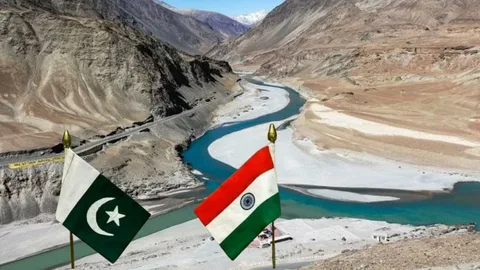

The Permanent Court of Arbitration in The Hague has ruled that India must continue observing the Indus Waters Treaty with Pakistan and pause construction work on its Ratle hydroelectric plant. The order marks the latest development in a dispute that has run since India placed the 1960 water-sharing agreement in abeyance last year.
Background: How This Dispute Began
The Indus Waters Treaty was signed in 1960 and has governed how India and Pakistan share the waters of the Indus river system ever since, surviving multiple wars between the two countries over the decades. India put the treaty in abeyance in April 2025, tying the move to a deadly attack in Pahalgam, in Indian-administered Kashmir, that killed 26 civilians.
New Delhi linked the attack to Pakistan, though it did not present public evidence for that claim, and Islamabad denied any involvement. The abeyance was followed by a brief military confrontation between the two countries in May 2025, and water-sharing has remained one of the most contentious issues between them since.
What The Court Actually Ordered
The Hague-based tribunal, a five-member panel chaired by Prof. Sean D. Murphy, issued both an award on the treaty’s current legal status and a separate order on interim measures tied to the Ratle hydroelectric plant. It found that the treaty remains in force and that neither country can suspend or withdraw from it without the other’s agreement, rejecting the idea that a unilateral abeyance changes that legal standing.
On the Ratle project specifically, the court restricted India’s ability to store or otherwise disrupt flows on the Indus, Jhelum, and Chenab rivers while the matter is reviewed further. It also said a neutral expert appointed by the World Bank, which helped broker the original 1960 agreement, would assess by mid-2027 whether the hydroelectric plant’s design complies with the treaty’s terms.
Quotes and Official Reaction
Pakistan’s government said it received the ruling with what it called complete satisfaction, describing it as reinforcing the country’s long-standing position on the treaty. Pakistani officials have previously said that any move to suspend their share of the water would amount to an act of war, pointing out that the treaty text includes no clause allowing one side to suspend it alone.
India, for its part, keeps saying it doesn’t recognize the Court of Arbitration’s authority in this matter, and that the proceedings were improperly constituted from the start. That stance means Monday’s ruling probably won’t shift India’s approach on its own even though the tribunal has said its jurisdiction stands regardless of India’s objections.
Impact: Why the Ruling Matters Beyond the Courtroom
The Indus system supplies water that’s essential to agriculture across large parts of Pakistan, so any disruption to flows on the western rivers carries direct economic weight for the country. Because the treaty has held even through previous India-Pakistan wars, its current uncertainty is being watched closely as a signal of how fragile bilateral relations have become since the Pahalgam attack.
The ruling also puts fresh attention on the World Bank’s role as the treaty’s original broker, since it’s now the institution tasked with appointing the neutral expert who’ll assess whether the Ratle project complies. How India handles that process — given its stated rejection of the court’s authority — will probably decide whether this dispute inches toward resolution or just stays stuck where it is.
Conclusion: What Happens Next
The neutral expert’s assessment of the Ratle plant isn’t due until mid-2027, leaving the underlying dispute unresolved for some time yet. Pakistan has said it remains committed to the treaty’s dispute-resolution mechanisms, while India has given no public indication that it intends to reverse the abeyance or formally re-engage with the arbitration process. Further diplomatic movement, if any, is likely to depend on the broader state of India-Pakistan relations rather than on this ruling alone.
FAQs
Which rivers flow to Pakistan from India under the Indus Waters Treaty?
The treaty divides the Indus river system into two groups. The western rivers, the Indus, Jhelum, and Chenab, were allocated largely for Pakistan’s use, while the eastern rivers, the Ravi, Beas, and Sutlej, were allocated to India. India is permitted limited use of the western rivers for purposes like irrigation, non-consumptive use, and run-of-river hydroelectric power, which is precisely the kind of project, like the Ratle plant, that tends to generate disputes over technical design and downstream impact.
Who brokered the Indus Waters Treaty?
The World Bank brokered the agreement, mediating nearly a decade of negotiations between India and Pakistan before the treaty was signed in September 1960 by Indian Prime Minister Jawaharlal Nehru and Pakistani President Ayub Khan. The World Bank remains formally involved in the treaty’s framework today, including its role in appointing the neutral expert now examining the Ratle hydroelectric project.
What are the benefits of the Indus Waters Treaty?
The treaty gave both countries a predictable, legally binding framework for sharing a river system that both depend on heavily for agriculture and drinking water, which is a large part of why it has survived multiple wars between them since 1960. It also set up formal channels, including neutral experts and arbitration, for resolving technical disputes over dam and hydroelectric project designs without those disagreements escalating into broader conflict, at least until the treaty’s current standing came into question.