
Pakistan is in the middle of its most serious conversation about new provinces in Pakistan in years. A proposed 28th Constitutional Amendment has put a plan to create up to 12 new provinces in Pakistan on the table, replacing the current four-province structure with a fundamentally different administrative map. Support and resistance are running almost exactly in parallel and with a constitutional amendment bill reportedly set to be tabled in parliament next month, the debate has moved from theory to timeline.Here is what the proposal actually involves, who is backing it, who is fighting it, and why this question has resisted resolution for decades.
Background: Why Pakistan Is Talking About New Provinces Again
The fundamental problem is size. Punjab alone accounts for more than half the country’s population and generates the bulk of its economic activity. That concentration of population and resources within a single province has consistently fed resentment in the south, north, and west of Punjab itself, as well as among smaller ethnic communities across Sindh and KP who feel their regions are administratively marginalised.
The demand for new provinces consistently provokes significant political anxiety. Proposals for administrative division often encounter intense resistance from majority ethnic groups, who regard existing provincial boundaries as sacred and historically significant homelands.The debate, as one recent analysis put it, “exposes a deeper structural flaw within the Pakistani state a rigid dichotomy between an imposed state nationalism and entrenched sub-national ethnolinguistic hegemonies.”
What Are the 12 New Provinces in Pakistan?
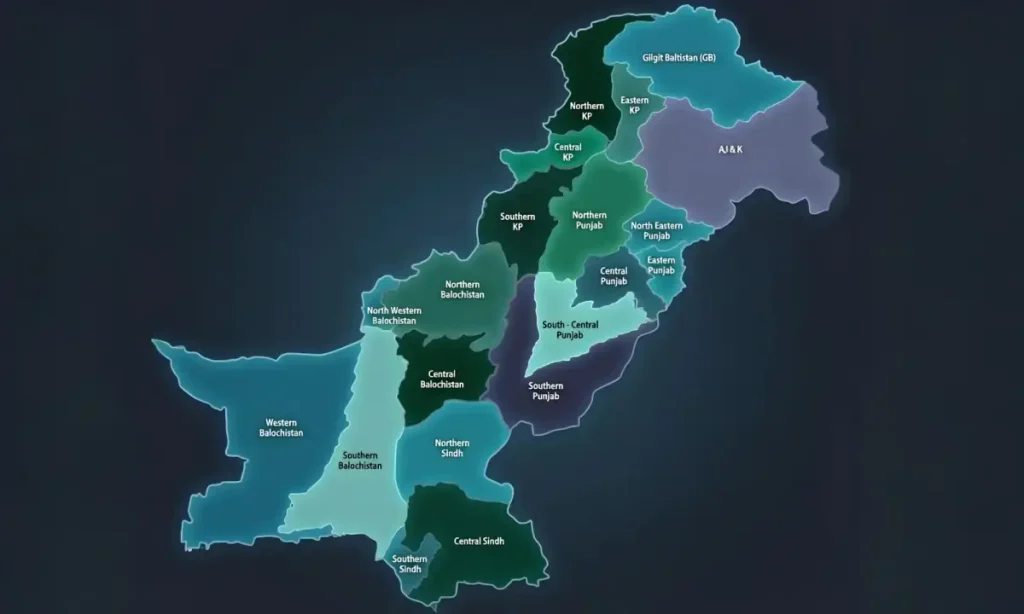
The proposed 12 new provinces in Pakistan, circulating under the 28th Amendment framework, include: Islamabad, West Punjab, South Punjab, Bahawalpur, Potohar, Karachi, Sindh, Mehran, Balochistan, Gwadar, Khyber, and Hazara.
zara and Bahawalpur
Two of the new provinces in Pakistan proposals have the longest history and the most organised political backing.The Hazara province demand comes from the Hindko-speaking districts of northern KP, which have long argued they are culturally distinct from the Pashtun majority and administratively neglected. The demand has been active since at least the 1970s.
South Punjab sometimes called Saraikistan is the third major demand.South Punjab generally refers to the three southern divisions of Punjab: Multan, Bahawalpur, and Dera Ghazi Khan. PTI promised to create a South Punjab province within its first 100 days in office after winning the 2018 election, though that commitment was not fulfilled. In 2022, the Senate accepted a bill seeking the creation of a South Punjab province.
What the Bill Proposes The 28th Amendment
Former Information Minister Muhammad Ali Durrani announced that a constitutional amendment seeking the immediate restoration of the Bahawalpur province and the creation of Hazara province will be tabled in Parliament next month. “The draft for constitutional amendment has been prepared,” Durrani said, adding that the debate had “entered a decisive stage” after 18 years of political work on the issue. “This is the very path that can take Pakistan out of the quagmire of administrative, economic and social problems,” he said.
The constitutional process for creating new provinces in Pakistan requires a two-thirds majority in both the National Assembly and the Senate, plus the consent of the relevant provincial assembly. That consent requirement is what has blocked most previous attempts Punjab’s assembly has historically refused to approve the creation of new provinces from its own territory.
Who Supports New Provinces in Pakistan?
Istehkam-e-Pakistan Party President Abdul Aleem Khan backed the creation of new provinces, describing it as a national issue that should not be sacrificed for political expediency. He voiced support for South Punjab and Bahawalpur provinces. PTI Chairman Barrister Gohar Ali Khan also endorsed the idea, saying the country required additional administrative units. MQM-P has proposed a national dialogue on the framework for new provinces.
Who Is Resisting the Proposal?
The National Party declared a firm stance against the proposed division of existing provinces, pledging to launch a political movement to thwart any attempts to restructure Pakistan’s administrative boundaries. Former Balochistan chief minister Dr Abdul Malik Baloch criticised the proposal, characterising the creation of new administrative zones as an unnecessary distraction from pressing national crises. “Fabricating a debate over a non-issue is a deliberate attempt by the ruling authorities to deflect public scrutiny from core socio-economic challenges,” Dr Malik said. He affirmed that his party would mobilise public opinion and utilise all political avenues to resist the reconfiguration of provincial borders.
The Core Challenges Making New Provinces in Pakistan Work
Constitutional Hurdles
A constitutional amendment requires a two-thirds majority in both houses plus the relevant provincial assembly’s consent. Getting Punjab’s provincial assembly to vote for its own division has been the stumbling block every time the debate has reached this point.
Financial Costs
Creating new provinces means new assemblies, new civil secretariats, new high courts, new bureaucracies. The recurring cost of running twelve provinces rather than four would be substantial, and Pakistan’s current fiscal position makes that a difficult argument to win in public.
Ethnic and Political Fault Lines
The issue of creating new provinces in Pakistan is inseparable from ethnolinguistic politics. Every proposed boundary line has constituencies that feel included and constituencies that feel left out. The Saraiki belt and the Hazara region both have legitimate administrative grievances, but the political coalitions required to draw new boundaries without creating new resentments are extremely difficult to assemble.
Governance Capacity
Some new provinces in Pakistan research paper assessments have questioned whether Pakistan’s administrative capacity can actually run twelve functioning provincial governments simultaneously. The existing four provinces have significant governance gaps particularly in Balochistan. Multiplying the number of administrative units doesn’t automatically improve the quality of administration.
Is a New Provinces in Pakistan PDF Available?
For those researching this topic academically, several detailed new provinces in Pakistan PDF resources are available through Dawn’s editorial archive, the Jinnah Institute’s policy publications, and academic journals focusing on South Asian federalism. The Commonwealth Foundation has also published background material on the history of provincial reorganisation proposals.
The new provinces in Pakistan research paper literature consistently identifies the same three obstacles: constitutional requirements, provincial assembly consent, and the lack of political consensus on which ethnic and administrative criteria should determine boundaries.
Conclusion
The debate over new provinces in Pakistan 2026 is more advanced than it’s been in years, with a specific amendment, a specific timeline, and specific proposals on the table. The constitutional, financial, and political obstacles remain exactly what they’ve always been but the government’s move to table a bill next month suggests at least some calculation that the political moment has shifted.
Whether that calculation is right, and whether the 28th Amendment actually clears the parliamentary hurdles it needs, will determine whether Pakistan’s administrative map changes for the first time in over fifty years — or whether this round ends as the previous rounds have.
Frequently Asked Questions
How many provinces are there in Pakistan in 2026?
Pakistan currently has four provinces: Punjab, Sindh, Khyber Pakhtunkhwa, and Balochistan. There are also two territories with varying degrees of administrative status Azad Jammu and Kashmir and Gilgit-Baltistan and the Islamabad Capital Territory. The proposal to create new provinces in Pakistan under the 28th Constitutional Amendment would increase this number to as many as twelve, but that amendment has not yet been passed. Until parliament acts and the relevant provincial assemblies consent, Pakistan remains a four-province federation.
How many provinces are in Pakistan 4 or 5?
Pakistan has four provinces as of 2026. There is no fifth province at present, though the debate around new provinces in Pakistan is more active than it has been in decades. Gilgit-Baltistan, which many Pakistanis colloquially refer to as a de facto province, does not have full constitutional provincial status. The proposed 28th Amendment would not just add one province but potentially restructure the entire administrative geography of the country, moving from four to as many as twelve administrative units.
Which provinces want to separate from Pakistan?
The demand for administrative separation within Pakistan meaning the creation of new provinces in Pakistan is different from demands for national separation. The Hazara movement in KP seeks its own province within Pakistan, not independence. The South Punjab and Bahawalpur movements are similarly administrative rather than secessionist. Balochistan is the province where a genuine separatist insurgency has been active for decades, driven by grievances over resource extraction, military operations, and the enforced disappearance of activists. The Baloch separatist movement represents a much more fundamental challenge than the administrative reorganisation debates happening in Punjab and KP, though both are symptoms of the same underlying question about how Pakistan distributes political and economic power.