
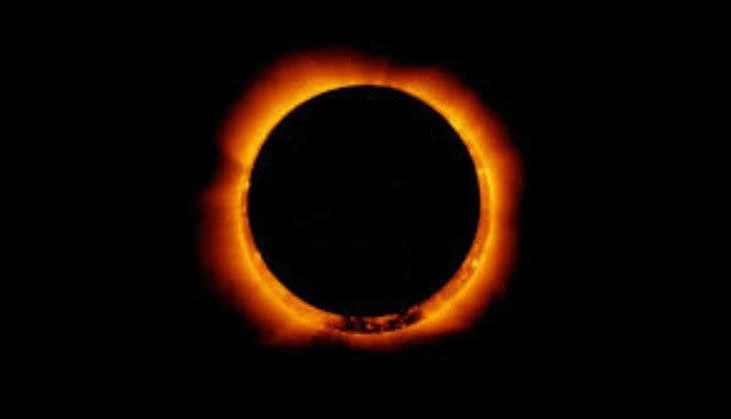

Pakistan Meteorological Department says the year’s final total solar eclipse will be visible across parts of Europe and the Arctic but not in Pakistan, while a partial lunar eclipse later this month will also miss the country.
KARACHI: The Pakistan Meteorological Department (PMD) has announced that the last total solar eclipse of 2026 will occur on the night of August 12-13, but the spectacular celestial event will not be visible in Pakistan.
According to the PMD, the total solar eclipse will begin at 8:34 PM Pakistan Standard Time (PST) on August 12, reach its maximum phase at 10:46 PM PST, and conclude at 12:58 AM PST on August 13.
Although skywatchers in Pakistan will not be able to witness the phenomenon, millions of people across Europe and other regions are expected to observe one of the most remarkable astronomical events of the year.
Where Will the Total Solar Eclipse Be Visible?
The PMD said the total solar eclipse will be visible from parts of Greenland, Iceland, Spain, and Russia, while a partial solar eclipse will be seen across several areas of Europe, Africa, and the Americas.
Astronomers describe the August 12 event as historically significant because it will be the first total solar eclipse visible from mainland Europe since 2006. The eclipse is expected to attract thousands of tourists, astronomers, photographers, and science enthusiasts to locations along the path of totality.
What Is a Total Solar Eclipse?
A total solar eclipse occurs when the Moon passes directly between the Earth and the Sun, completely blocking the Sun’s light for observers located within the eclipse’s path.
During totality, daylight briefly turns into twilight, allowing observers to see the Sun’s outer atmosphere, known as the corona—a rare sight that is normally hidden by the Sun’s intense brightness.
Scientists consider total solar eclipses among the most fascinating natural events because they provide valuable opportunities to study the Sun’s atmosphere and magnetic activity.
Why Is This Eclipse Special?
While one or two solar eclipses occur somewhere on Earth every year, a total solar eclipse is rare for any particular location because the Moon’s shadow follows only a narrow path across the Earth’s surface.
The August 2026 eclipse is especially important for Europe, as many countries on the continent have not experienced a total solar eclipse for nearly two decades.
Experts say the event will offer exceptional viewing conditions in several regions, making it one of the most anticipated astronomical phenomena of the year.
Future Solar Eclipses
The PMD also highlighted upcoming eclipse events for astronomy enthusiasts.
On August 2, 2027, another total solar eclipse will cross southern Spain, northern Africa, and the Arabian Peninsula. The period of totality will last an impressive 6 minutes and 23 seconds, making it one of the longest total solar eclipses of the century.
Astronomers note that an even longer total solar eclipse will not occur until 2114.
In addition, Spain will witness an annular solar eclipse, commonly known as the “Ring of Fire,” on January 26, 2028, when the Moon will cover the center of the Sun while leaving a bright ring visible around its edges.
Partial Lunar Eclipse on August 28
The PMD further announced that a partial lunar eclipse will occur on August 28.
However, similar to the total solar eclipse, the lunar eclipse will not be visible from Pakistan.
Astronomy enthusiasts in other parts of the world will be able to observe the event depending on local weather conditions and geographical location.
Eye Safety During Solar Eclipses
Astronomers strongly warn against looking directly at the Sun during any stage of a solar eclipse without certified eclipse glasses or approved solar viewing filters.
Viewing the Sun without proper eye protection can cause permanent retinal damage and irreversible vision loss, even if the eclipse appears partial.
Experts recommend using ISO-certified eclipse glasses or indirect viewing methods to safely enjoy the celestial phenomenon.
Scientific Importance of Solar Eclipses
Beyond their breathtaking beauty, total solar eclipses play an important role in scientific research.
They allow astronomers to study the Sun’s corona, solar winds, and magnetic field in greater detail, helping scientists improve their understanding of solar activity and its effects on Earth’s space environment.
Conclusion
Although the last total solar eclipse of 2026 will not be visible in Pakistan, it remains one of the year’s most significant astronomical events. With observers across Europe, Greenland, Iceland, Spain, and Russia preparing for the spectacle, scientists and astronomy enthusiasts alike are looking forward to a rare opportunity to witness one of nature’s most extraordinary displays.
SEO Package
SEO Title
Last Total Solar Eclipse of 2026 on August 12-13 Will Not Be Visible in Pakistan
Focus Keyword
Last Total Solar Eclipse of 2026
SEO Slug
last-total-solar-eclipse-2026-not-visible-pakistan
Meta Description
The Pakistan Meteorological Department says the last total solar eclipse of 2026 will occur on August 12-13 but will not be visible in Pakistan. Learn where the eclipse can be seen and why this celestial event is significant.
Meta Keywords
Last Total Solar Eclipse of 2026, Solar Eclipse 2026, Pakistan Meteorological Department, PMD, August Solar Eclipse, Total Solar Eclipse, Astronomy News, Space News, Pakistan News, Lunar Eclipse, Ring of Fire Eclipse
Image Alt Text
Last total solar eclipse of 2026 occurring on August 12-13, visible in parts of Europe but not Pakistan.
Image Caption
The last total solar eclipse of 2026 will be visible across Greenland, Iceland, Spain, and Russia, while Pakistan will not witness the celestial event.