
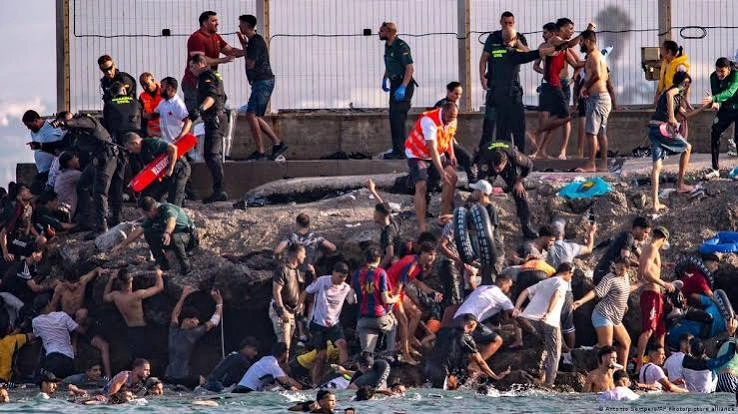

MADRID: The death toll from last week’s unprecedented migrant surge into Spain’s North African enclave of Ceuta has climbed to 72, according to Spanish officials, as authorities continue to respond to one of the largest migration crises the territory has ever experienced.
Local officials said tens of thousands of migrants attempted to reach Ceuta from neighboring Morocco, with many swimming around the border barrier or using other routes to enter the Spanish territory. The mass crossing, estimated at nearly 60,000 people, overwhelmed local authorities and triggered a humanitarian and political crisis.
Miguel Angel Perez Triano, the Spanish government’s representative in Ceuta, confirmed on Sunday that the number of fatalities had increased to 72, up from the previously reported 67 deaths. Officials have not yet released detailed information about the identities or nationalities of all those who lost their lives.
Most Migrants Return to Morocco
Authorities said the vast majority of migrants who crossed into Ceuta voluntarily returned to Morocco within 48 hours of the incident. By Sunday, only small groups of migrants remained in the enclave, while daily life had largely returned to normal.
Spanish police and military personnel continued to patrol the streets and key border areas as security remained on high alert. Rescue teams also maintained operations along the coastline to prevent further casualties and monitor the Mediterranean waters surrounding the enclave.
Tightened Border Security
Security measures around Ceuta have been significantly reinforced following the mass crossing. Rescue boats continued patrolling the waters near the border, while authorities deployed a new 500-meter floating barrier extending into the Mediterranean Sea to strengthen border protection.
The Spanish Civil Guard escorted groups of migrants back to the border crossing for their return to Morocco, while cleanup crews worked to remove clothing, personal belongings, and debris left behind during the large-scale migration.
Near Ceuta’s port, Spanish soldiers detained several exhausted migrants before transferring them to the appropriate authorities for processing.
Rumors and Smuggling Networks Under Scrutiny
Spanish officials blamed criminal smuggling networks for spreading false information that encouraged thousands of migrants to attempt the dangerous journey. According to the government, rumors circulated that a recent ruling by Spain’s Supreme Court would make it easier for migrants to enter and remain in the country.
Many migrants who crossed into Ceuta reportedly said they believed the border had been opened, a claim that rapidly spread across social media platforms and messaging apps.
Some political analysts also suggested that Morocco may have relaxed border controls to increase diplomatic pressure on Spain following Madrid’s improving relations with neighboring Algeria. However, Moroccan authorities have not publicly commented on those allegations.
Echoes of the 2021 Crisis
The latest migration wave has drawn comparisons to the events of 2021, when approximately 10,000 migrants entered Ceuta after Morocco temporarily eased border controls during a diplomatic dispute with Spain.
The scale of this year’s crossing, however, has been considerably larger, making it one of the most significant migration incidents in the enclave’s recent history.
European Response
The crisis has prompted concern across Europe. The European Union announced it will hold an emergency video conference after 22 member states jointly called for a coordinated response to manage migration flows and prevent similar incidents in the future.
Meanwhile, Italy announced a one-month suspension of the Schengen visa-free travel arrangement with Spain as part of its response to the growing migration concerns.
Spanish Prime Minister Pedro Sanchez criticized what he described as the “selfish” response of some European partners, urging greater solidarity and collective action to address irregular migration and strengthen the European Union’s external borders.
Authorities in Spain continue to monitor the situation closely while humanitarian agencies remain engaged in assisting migrants affected by the crisis. Investigations into the circumstances surrounding the deaths and the role of criminal trafficking networks are also ongoing.