

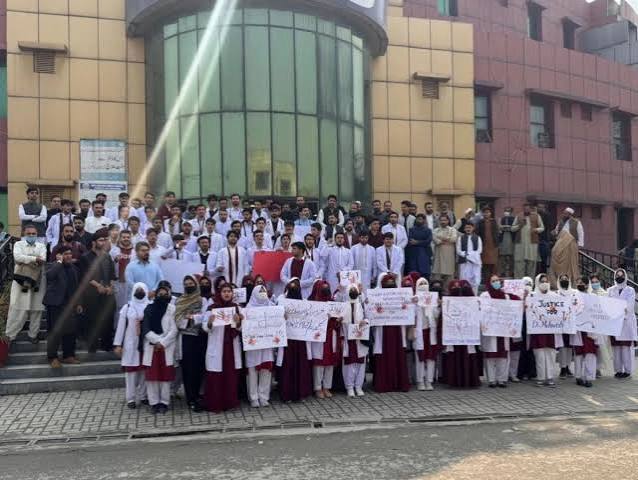
Doctors across Khyber-Pakhtunkhwa have escalated their ongoing strike into a full boycott of provincial hospitals. The decision followed a violent incident at Lady Reading Hospital (LRH) in Peshawar, where security personnel allegedly assaulted doctors who were staging a peaceful protest. The doctors say they will now stay away from their hospitals entirely out of concern for their own safety.
Background
The protest is not new. Doctors in Khyber-Pakhtunkhwa have been observing a pen-down strike for the past 24 days, pressing the provincial government for a 30 percent increase in basic salaries. The demand follows years of what doctors describe as stagnant pay that has failed to keep up with inflation.
The provincial government had earlier approved a 15 percent increase in stipends for Trainee Medical Officers and House Officers, with a further 5 percent annual rise built in going forward. Doctors’ associations rejected this as insufficient, pointing out that stipends had not been meaningfully revised since 2015 and calling for the full 30 percent they had originally demanded.
Details
The situation shifted sharply after an alleged assault on protesting doctors at LRH a day before the latest announcement. The Neutral Doctors Community, which has been coordinating the protest, said the incident left its members with no option but to withdraw from hospital wards altogether rather than continue the pen-down approach alone.
Speaking at a press conference held at the Peshawar Press Club, Community Chairman Dr Adnan Afridi confirmed that doctors would now combine the pen-down strike with a complete boycott of hospital duties. He was joined by colleagues from LRH, Hayatabad Medical Complex, Khyber Teaching Hospital and other facilities from across the province, underlining how widely the protest has spread beyond a single institution.
Dr Afridi also accused the provincial health department of deliberately dragging out negotiations instead of addressing the doctors’ demands directly. He further alleged that senior officials, including the health secretary, had been stringing doctors along under the appearance of dialogue without any real intention of resolving the dispute.
Quotes
Dr Afridi issued a pointed warning regarding the safety of doctors who are now staying home as part of the boycott. He stated that any attempt to intimidate doctors at their residences would be met with firm resistance, underscoring the level of tension the assault at LRH has generated among the medical community.
Impact
The escalation threatens to disrupt hospital services across multiple major facilities in Khyber-Pakhtunkhwa, including some of the province’s busiest public hospitals in Peshawar. A full boycott, rather than a partial pen-down protest, raises the risk of real disruption to patient care, particularly for those relying on outpatient and elective services at LRH, HMC and KTH.
The dispute also highlights a broader, recurring problem in Pakistan’s public healthcare system: friction between underpaid junior doctors and provincial health administrations, which has repeatedly spilled into strikes and boycotts in Khyber-Pakhtunkhwa over the past several years.
Conclusion
With doctors now framing this as a safety issue rather than purely a pay dispute, pressure is mounting on the provincial government to respond quickly. Whether talks resume, and how the alleged assault at LRH is investigated, are likely to determine how long the boycott lasts and whether it spreads to additional hospitals across the province.
Frequently Asked Questions
What is the latest update on the Khyber-Pakhtunkhwa doctors’ strike?
As of the most recent developments, doctors in Khyber-Pakhtunkhwa have escalated their 24-day pen-down strike into a full boycott of hospital duties. The move came after security personnel allegedly assaulted doctors who were peacefully protesting at Lady Reading Hospital in Peshawar. The Neutral Doctors Community, representing doctors from LRH, Hayatabad Medical Complex and Khyber Teaching Hospital, announced that members would now stay away from hospitals entirely rather than continue working under the earlier, more limited protest format. The doctors are demanding a 30 percent increase in basic salaries, after rejecting a 15 percent stipend increase announced by the provincial government as insufficient.
Does the strike affect outpatient and emergency services at KP hospitals?
Strikes of this kind in Khyber-Pakhtunkhwa have historically affected outpatient departments (OPDs) and elective services most directly, since doctors involved in pen-down protests typically continue attending to emergency cases even while boycotting routine duties. However, a full boycott, as announced after the LRH assault, raises the risk of broader disruption, since doctors say they will withdraw from hospital wards altogether rather than maintain a partial protest. Patients at major facilities including LRH, HMC and KTH are likely to face delays and reduced access to non-emergency care while the boycott continues.
What triggered the latest escalation of the doctors’ protest?
The immediate trigger was an alleged assault by security personnel on doctors who were staging a peaceful protest at Lady Reading Hospital. This incident occurred against the backdrop of an already ongoing 24-day pen-down strike over salary demands. Doctors’ representatives say the assault, combined with what they describe as deliberate stalling by the provincial health department during negotiations, left them with no choice but to escalate from a pen-down protest to a full hospital boycott. The doctors have also demanded guarantees for their safety, both inside hospital premises and at home, as part of resolving the dispute.
Leave a comment