

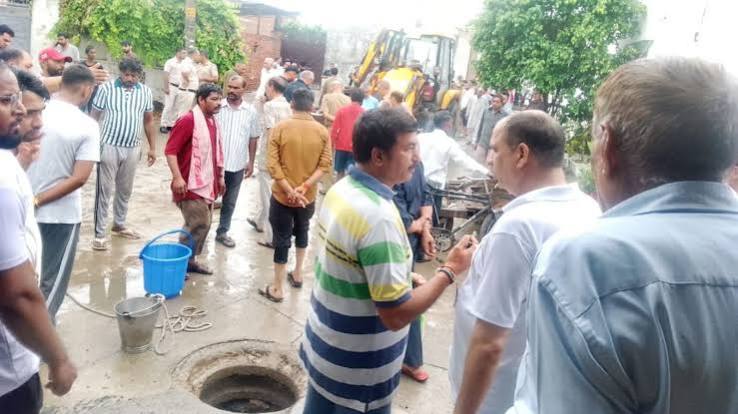
A nine-year-old boy drowned on Saturday after falling into an open drain along a footpath in Karachi’s Agra Taj Colony. The child, identified as Ayan Baloch, was pulled from the drain by police and Edhi volunteers, but he had already died by the time his body was recovered.
Background
The incident occurred near the Edhi workshop at the Agra Taj Colony bus stop on Mauripur Road, an area that falls under the jurisdiction of the Kalri police station. Open and poorly covered drains remain a recurring hazard in several parts of Karachi, where ageing drainage infrastructure and missing manhole covers have repeatedly put pedestrians, and especially children, at risk.
Details
According to police, Ayan Baloch, son of Shahbaz Ali and a resident of Gul Muhammad Lane in Lyari, fell into the open drain while in the area. Police and Edhi volunteers reached the site after being alerted and retrieved his body from the drain.
The body was shifted to Civil Hospital Karachi, where it was formally identified. After completing the necessary legal formalities, police handed the body over to the family for burial.
No further details have been released about the exact circumstances that led to the child falling into the drain, and authorities have not yet indicated whether any action will be taken regarding the condition of the drain itself.
Impact
Incidents involving open drains and uncovered manholes have occurred repeatedly across Karachi and other Pakistani cities in recent years, often involving young children who are especially vulnerable near unguarded drainage channels. Residents in various neighbourhoods have previously staged protests and called on civic authorities to install proper covers and barriers after similar tragedies, though such demands have often gone unaddressed for extended periods.
Each new case adds to long-standing concerns among residents and civil society groups about the state of Karachi’s drainage network, particularly in older and densely populated localities where infrastructure maintenance has lagged behind the city’s growth.
Conclusion
As with previous cases, attention is likely to turn toward the condition of drains and manholes in Agra Taj Colony and neighbouring areas in the days ahead. Whether this latest tragedy prompts any concrete steps from the relevant civic bodies to cover exposed drains and prevent further loss of life remains to be seen.
Frequently Asked Questions
Why are open drains a common hazard in Karachi?
Open drains remain a persistent hazard in Karachi largely because of ageing and poorly maintained sewerage infrastructure, missing or broken manhole covers, and slow civic response to reported damage. Many drainage channels run close to footpaths and residential streets without adequate fencing or covering, meaning that even a routine walk near these areas can pose a serious risk, particularly to young children who may not recognise the danger. Despite repeated incidents and public complaints over the years, comprehensive repair and covering of the city’s drainage network has been inconsistent, leaving many neighbourhoods exposed to the same recurring risk.
What should be done to prevent children from falling into open drains?
Preventing such incidents generally requires a combination of infrastructure fixes and community awareness. This includes civic authorities promptly repairing or replacing missing manhole and drain covers, installing protective fencing or railings along exposed drainage channels in residential and high-traffic areas, and conducting regular inspections rather than waiting for complaints or accidents to prompt action. On the community side, parents and caregivers are often advised to keep a closer watch on young children playing outdoors near known hazardous spots, and residents are encouraged to report damaged or uncovered drains to local authorities as soon as they are noticed, rather than after an incident occurs.
What happens after a child drowning case is reported to police in Pakistan?
When such an incident is reported, local police typically coordinate with rescue or welfare organisations, such as Edhi, to recover the body and secure the scene. The body is generally shifted to a government hospital for formal identification and to complete legal and medical formalities, such as confirming the cause of death. Once these procedures are completed, police release the body to the family for burial. Depending on the circumstances, authorities may also examine whether negligence, such as an improperly covered drain, contributed to the incident, though in many past cases in Pakistan, this has not always led to swift infrastructure repairs or accountability measures.
Leave a comment