

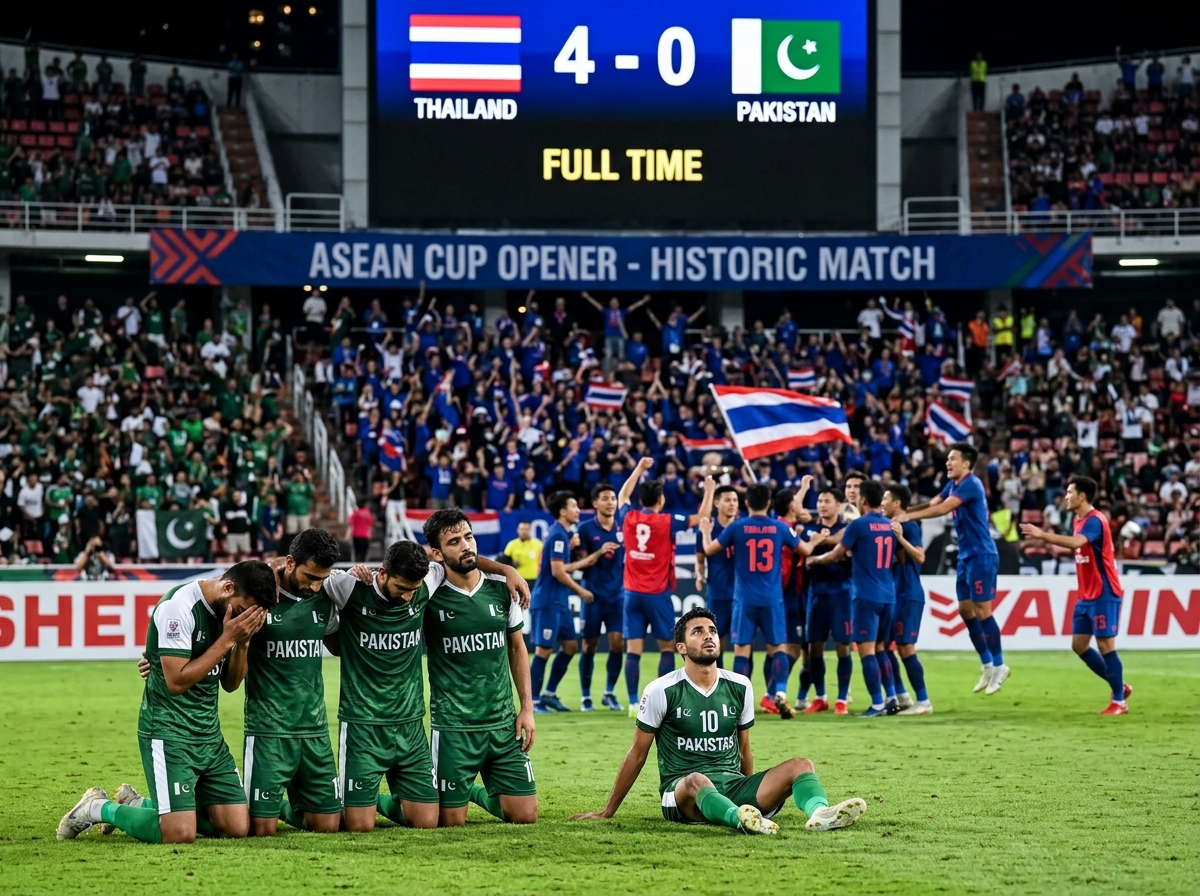
Pakistan’s first-ever appearance at a men’s FIFA tournament ended in a heavy 4-0 defeat to Thailand on Saturday. Teerasak Poeiphimai scored twice, while Jude Soonsup-Bell and an own goal from Haris Zeb completed the scoring at the Si Jalak Harupat Stadium in Bandung, Indonesia.
Background
The match marked Pakistan’s Group B opener at the inaugural FIFA ASEAN Cup 2026, a newly created tournament run directly by FIFA rather than the regional ASEAN Football Federation. The competition expanded beyond its usual Southeast Asian membership this year, inviting Pakistan and Hong Kong to take part alongside the established regional sides.
Pakistan arrived in Indonesia on the back of a genuine high point for their football programme, having recently won the Diamond Jubilee International Tournament in the Maldives, their first international title in 74 years. Thailand, by contrast, entered as one of the region’s traditional heavyweights and one of the pre-tournament favourites in Group B, which also includes Vietnam and the Philippines.
Details
Pakistan showed early discipline under head coach Nolberto Solano, defending in numbers and limiting Thailand to speculative efforts from distance during the opening half-hour. Mohibullah made a crucial interception, Ali Raza produced a well-timed sliding tackle, and goalkeeper Yousuf Butt kept the scoreline blank with a smart save just before the half-hour mark.
The breakthrough came in the 31st minute, when Butt could only parry a header from Soonsup-Bell into the path of Poeiphimai, who reacted quickest to finish from close range. Thailand doubled their lead ten minutes later after Pakistan captain Abdullah Iqbal misplaced a pass in a dangerous area, allowing Soonsup-Bell to race through and slot home from close range.
Pakistan brought on experienced forward Kaleemullah Khan in search of a way back into the match, but Thailand remained firmly in control. Their third goal arrived in the 64th minute when a Poeiphimai effort deflected off Pakistan defender Haris Zeb and looped into the net as an own goal. Poeiphimai completed the scoring in the 84th minute, capitalising on a mix-up in the Pakistan defence to lift the ball over Butt.
Quotes
FIFA’s official post-match report credited Pakistan’s defensive effort in the opening stages, noting that the side limited a “regional power” for long spells before Thailand’s quality eventually told in the second half. The same report pointed to Thailand’s squad depth as a deciding factor, highlighting how substitute Supachai Chaided made an immediate impact by teeing up Poeiphimai’s third goal within minutes of coming on.
Impact
For Pakistan, the result is a reality check after their recent Maldives success, underlining the gap between competing at regional invitational level and facing an established Southeast Asian football nation in Thailand. Ranked 198th in the world, Pakistan’s competitive exposure at this level remains limited, and the manner of the defeat, particularly the two individual errors that led directly to goals, will be an area for the coaching staff to address quickly.
For Thailand, the win moves them to the top of Group B on three points and sets up what is being billed as the standout fixture of the group stage: a meeting with Vietnam on September 29. The result also keeps alive Thailand’s ambitions of reaching the final of the tournament’s top-tier Division 1, which will be contested by the two group winners.
Conclusion
Pakistan will look to regroup quickly before their next Group B match against the Philippines on Tuesday, a fixture they will need to approach with more composure if they are to pick up their first points of the tournament. Thailand, meanwhile, turn their focus to a heavyweight clash with Vietnam that could go a long way toward deciding who tops Group B and advances to the Division 1 final.
Frequently Asked Questions
Who qualified for the World Cup 2026 from Asia?
The Asian Football Confederation secured eight direct qualifying places for the 2026 FIFA World Cup, up from five in previous editions because of the tournament’s expansion to 48 teams. The confirmed AFC qualifiers include Japan, Iran, South Korea, Jordan, Australia, Uzbekistan, Saudi Arabia and Qatar, several of which, including Jordan and Uzbekistan, will be making their World Cup debut. Iraq also remained in contention for a place through the inter-confederation play-off route after the main qualifying rounds concluded. Notably, Pakistan does not compete in AFC’s World Cup qualifying pool at a level anywhere near these nations, which is part of why the FIFA ASEAN Cup represents such a significant step up in competition for a side ranked 198th in the world.
Did Vietnam win the ASEAN Cup?
Yes, but it is worth clarifying which competition is being referred to. Vietnam won the most recent edition of the traditional ASEAN Championship, formerly known as the AFF Cup, defeating two-time defending champions Thailand 5-3 on aggregate across a two-legged final in January 2025. That title was Vietnam’s third in the tournament’s history, following earlier wins in 2008 and 2018. The FIFA ASEAN Cup that Pakistan is currently competing in is a separate, newly launched tournament run directly by FIFA rather than the ASEAN Football Federation, and its inaugural champion had not yet been decided at the time of Pakistan’s defeat to Thailand.
What countries are in the ASEAN Cup?
The inaugural FIFA ASEAN Cup 2026 features 14 teams split across two divisions. Division 1, hosted in Indonesia, includes Indonesia, Malaysia, Singapore and India in Group A, and Vietnam, Thailand, the Philippines and Pakistan in Group B. Division 2, hosted in Hong Kong, includes Hong Kong, Myanmar and Brunei in one group, and Cambodia, Laos and Timor-Leste in the other. The format is notable for including two invited nations, Pakistan and Hong Kong, from outside the Association of Southeast Asian Nations’ usual 11-member football federation, making this edition considerably broader in scope than the traditional ASEAN Championship that Vietnam currently holds.
Leave a comment