

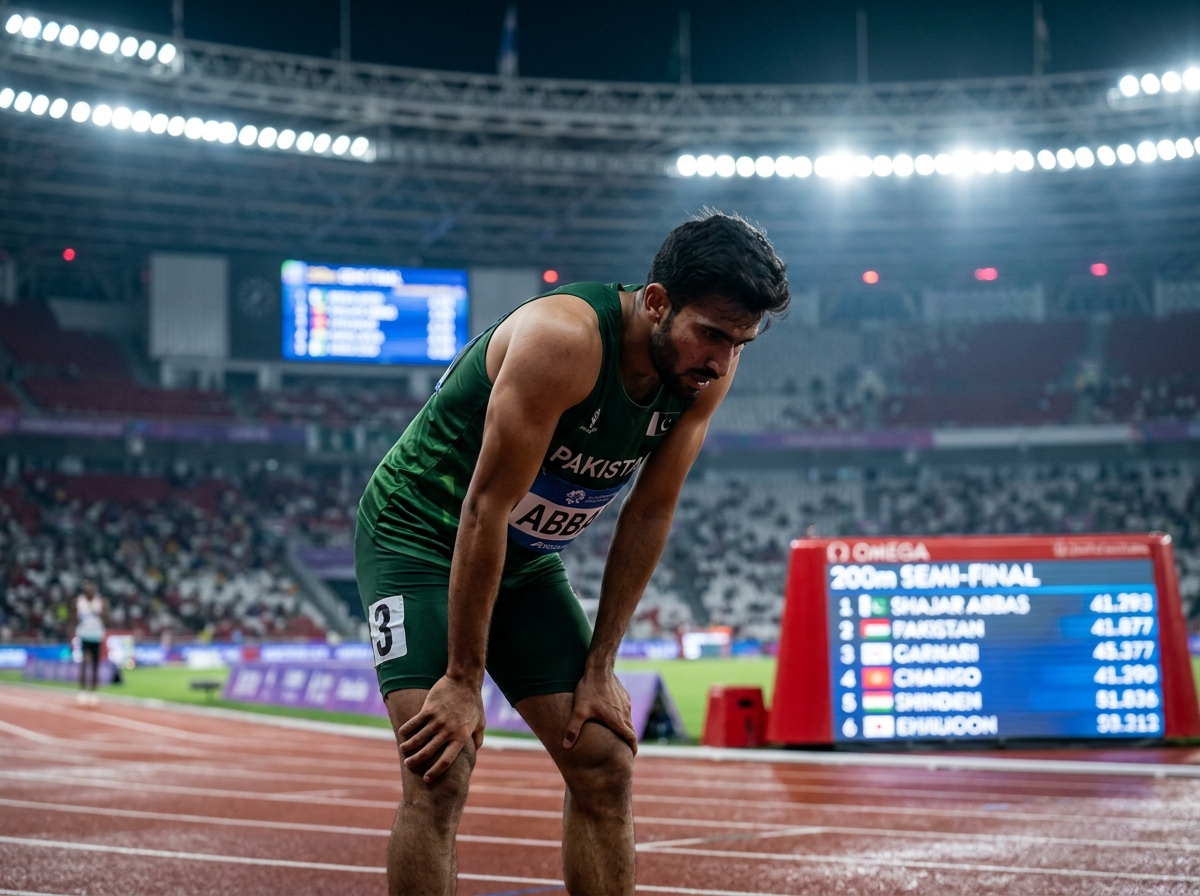
Pakistan’s Shajar Abbas was knocked out in the semi-final round of the men’s 200m at the Asian Games in Nagoya on Saturday. The sprinter finished 17th overall after clocking a time slower than the one that had carried him through the earlier round.
Background
Abbas had booked his place in the semi-finals earlier in the day with a time of 21.23 seconds, finishing third in his heat at the Nagoya City Mizuho Park Athletic Stadium. That run was enough to see him progress at 17th overall in the opening round, in a field where several sprinters were separated by only fractions of a second.
The 200m has been one of the events Pakistan’s athletics contingent has pinned some hope on at these Games, with Abbas having previously reached the semi-final stage at both the Commonwealth Games and the Asian Athletics Championship in recent years. His personal best of 20.87 seconds remains a national record.
Details
Abbas lined up in heat three of the semi-finals in the evening session but was unable to improve on his morning performance. He crossed the line in 21.30 seconds, finishing eighth in his heat, which was 0.07 seconds slower than his qualifying time and not enough to advance to the final.
Thailand’s Puripol Boonson won the heat comfortably in 20.10 seconds. Japan’s Soshi Mizukubo took second place in 20.37 seconds, while China’s Huang Youwen rounded out the top three with a time of 20.42 seconds. Only the top eight finishers across all semi-final heats progressed to the final, and Abbas’s time left him well outside that mark.
In the same session, Pakistan’s Khoula Omer Khan also had a difficult outing, finishing 23rd out of 26 competitors in the women’s 200m first-round heats with a time of 26.53 seconds.
Impact
The result means Pakistan’s athletics team leaves the men’s 200m event without a finalist at this year’s Games, extending a run of near-misses for Abbas at major championships. For a sprinter who has repeatedly come close to breaking through on the international stage, the outcome in Nagoya adds to the pressure heading into the remaining track events.
For Pakistan’s broader athletics program, the result highlights a continuing gap against the region’s stronger sprinting nations, with Thailand, Japan and China all producing faster times across the semi-final heats.
Conclusion
Attention now turns to Pakistan’s remaining athletes still competing in Nagoya, as the country looks for a stronger showing in the days ahead. For Abbas, the focus will likely shift to upcoming regional meets, where he will look to rediscover the form that has previously carried him to semi-final finishes on the global stage.
Frequently Asked Questions
What is considered a semi-final in athletics?
In track events like the 200m, a semi-final is the penultimate round before the final, used to narrow down a larger field of qualifiers from the heats. Athletes are typically split into several semi-final heats, and only a set number of the fastest finishers, usually the top few from each heat plus a number of the next-fastest overall times, move on to compete in the final. This system helps ensure that the strongest performers on the day reach the medal race, even if the overall field size makes a single round impractical.
Where and when is the next World Athletics Championship?
The next edition of the World Athletics Championships is scheduled to be held in Beijing, China, from September 13 to 21, 2025, followed by a subsequent edition planned for Budapest, Hungary. Exact dates and formats for editions beyond that are set by World Athletics and can shift, so it’s worth checking World Athletics’ official website closer to the date for confirmed scheduling, ticketing and broadcast details.
How did Pakistan’s other athletes perform at the Asian Games in Nagoya?
Alongside Shajar Abbas’s exit in the 200m semi-finals, Pakistan’s Khoula Omer Khan was eliminated in the first round of the women’s 200m, finishing 23rd out of 26 competitors. Pakistan’s broader athletics campaign in Nagoya has featured entries across sprinting and field events, though results in the shorter sprints have generally trailed the region’s traditional powerhouses, including Japan, China and Thailand.
Leave a comment