

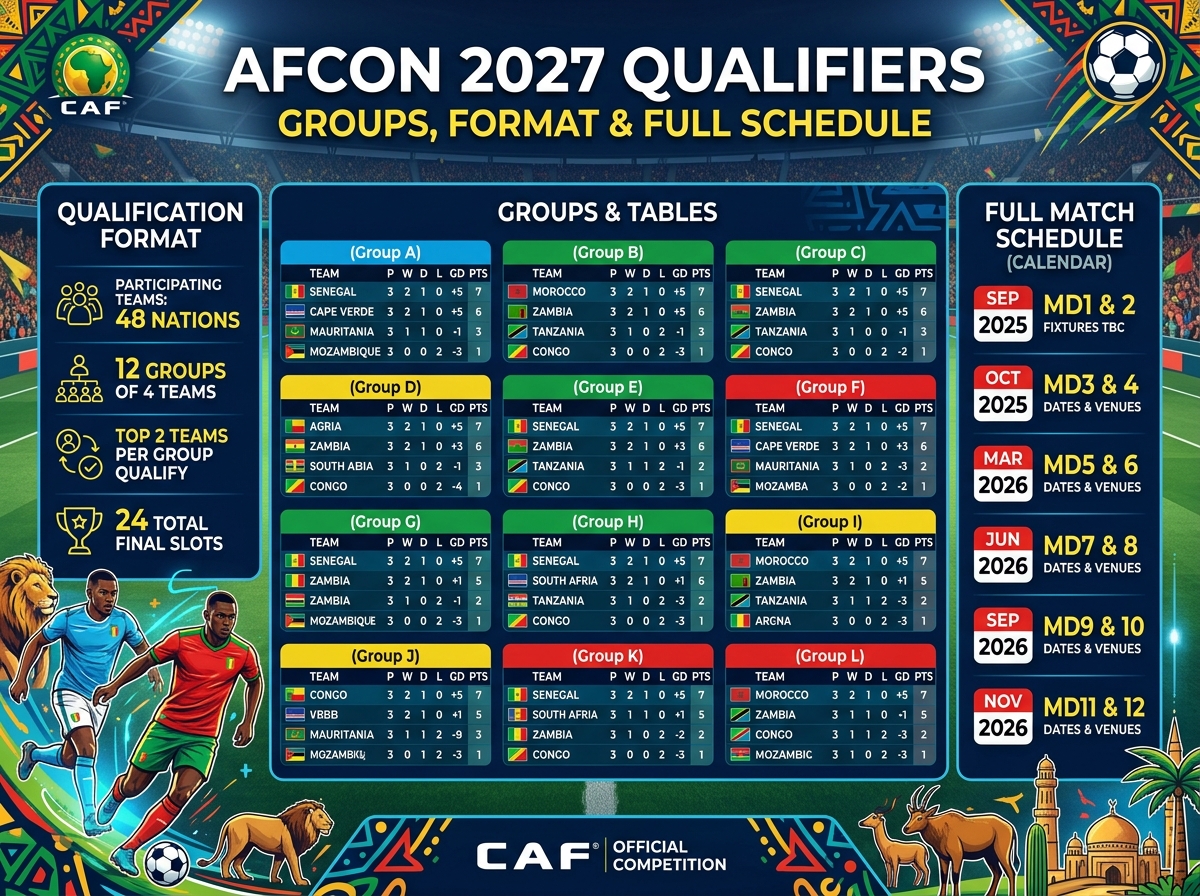
The race for a place at the 2027 Africa Cup of Nations has officially started. Forty-eight African national teams have been placed into twelve qualifying groups, and every one of them is chasing one of the twenty-four available spots at the finals. For many of these countries, the next six months of fixtures will decide their entire international calendar through mid-2027.
The tournament carries the official name PAMOJA 2027 and will be jointly hosted by Kenya, Tanzania and Uganda. This matters beyond the football itself, because it marks the first time in fifty-one years that the AFCON finals will be staged in East Africa, a region that has waited a long time for this moment.
Background: How the Draw Was Made
The qualifying draw for AFCON 2027 was held in Cairo, Egypt, back in May 2026, long before a ball had even been kicked. Former African football stars Max-Alain Gradel, William Troost-Ekong, Essam El Hadary and Trésor Mputu were brought in to conduct the draw ceremony, adding weight to an occasion that shaped the qualifying path for the next year.
The finals themselves are scheduled to run from 19 June to 17 July 2027. Confirmation that matches will be spread across all three host countries has already generated excitement among fans in East Africa, many of whom are seeing a home tournament for the very first time in their lifetimes.
AFCON 2027 Qualifying Groups
Here is a full breakdown of the groups confirmed at the official CAF draw in Cairo.
Group A Morocco headline this group, alongside Gabon, Niger and Lesotho. Morocco enter as one of the continent’s strongest sides, having impressed at recent major tournaments, so this group is expected to be one-sided on paper, though qualifying campaigns often produce surprises.
Group B Egypt lead a group that also includes Angola, Malawi and South Sudan. Egypt remain one of the most successful AFCON nations in history, and they will be expected to top this section comfortably across the six-match schedule.
Group C Ivory Coast, the 2024 champions, were drawn alongside Ghana, The Gambia and Somalia. This group has already produced the most talked-about fixture of the opening matchday, given the history between Ivory Coast and Ghana as two of West Africa’s most decorated football nations.
Group D (Host Group – Kenya) South Africa and Guinea join co-host Kenya and Eritrea in this section. Because Kenya has already secured its finals place as a host nation, only the best-placed team among South Africa, Guinea and Eritrea will earn qualification from this group.
Group H (Host Group – Uganda)Uganda anchor this group as one of the three co-hosts. As with the other host groups, Uganda’s own results will not count toward a second qualification place, meaning the other three nations will fight it out for one available spot.
Group J Senegal, the 2022 AFCON champions, were drawn against Mozambique, Sudan and Ethiopia. Senegal will start as clear favourites given their recent pedigree, but Sudan and Ethiopia have shown they can be competitive on their day.
Group L (Host Group – Tanzania Nigeria face Madagascar, Guinea-Bissau and co-host Tanzania in this section. Nigeria, three-time AFCON champions, will be aiming to finish as the top non-host nation in the group to secure their place at the finals.The remaining groups, E, F, G, I and K, round out the full 48-team field, giving every corner of the continent a representative chasing a finals berth.
Qualification Format Explained
Under the standard qualifying rule, the top two teams from each group progress directly into the 24-team finals tournament. This format rewards consistency across all six matchdays, rather than a single strong result.Because of this arrangement, in Groups D, H and L, only the best-placed team among the other three nations in that group will earn qualification. The host nation’s group results are effectively for competitive purposes only and do not affect the qualification picture in any way.
This system produces a total of 21 qualifiers from the group stage. Combined with the three automatically qualified host nations, the full 24-team field for AFCON 2027 will be complete once the final round of matches concludes.
When Do AFCON 2027 Qualifiers Start?
The group stage officially got underway on Thursday, September 24, 2026, with Matchdays 1 and 2 running through until October 6. This opening window gave fans their first look at how the new qualifying cycle would unfold across all twelve groups.The final two rounds, Matchdays 5 and 6, are set to be played between March 22 and 30, 2027. By the end of that window, the complete list of 24 finalists will be confirmed, closing out one of the longest qualifying campaigns in recent AFCON history.
Impact: What This Means for African Football
The decision to award hosting rights to three East African nations jointly is already being seen as a major boost for football development in the region. Automatic qualification gives Kenya, Tanzania and Uganda the chance to build their squads without the usual qualifying pressure, while also generating significant local excitement.
Conclusion: What Comes Next
With matchday one now underway, all focus shifts to results from the opening round of fixtures across the twelve groups. As qualifying began, every team started on zero points, meaning the coming weeks will be crucial in shaping early group standings.
The picture will become significantly clearer once Matchdays 1 and 2 are completed in early October, giving fans and analysts their first real read on which nations are best placed to reach the 2027 finals in East Africa.
Frequently Asked Questions
How many teams are competing in the AFCON 2027 qualifiers?
A total of 48 African national teams are competing across 12 qualifying groups of four teams each. Every one of these nations is aiming for one of the 24 spots available at the AFCON 2027 finals, which will be jointly hosted by Kenya, Tanzania and Uganda in June and July 2027.
How many teams qualify from each group?
In most of the twelve groups, the top two finishers at the end of six matchdays qualify directly for the finals tournament. However, the three groups containing host nations Kenya, Uganda and Tanzania work differently, since only the highest-placed non-host team from those sections advances, because the hosts have already secured their places automatically.
Have any teams already qualified for AFCON 2027?
Yes, three nations have already secured their spots. Kenya, Tanzania and Uganda qualified automatically as co-hosts of the tournament long before the group-stage qualifiers even began. No other nation has yet clinched a place, since the qualifying campaign only started in September 2026 and still has several months to run.
Leave a comment