

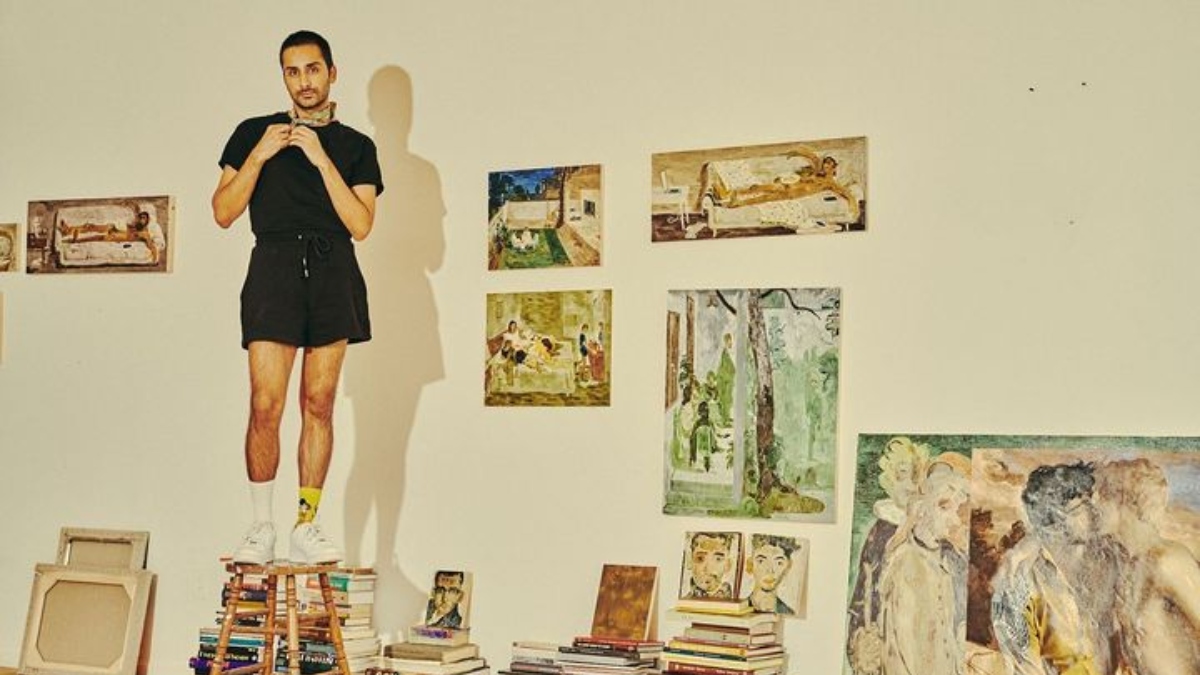
For anyone new to his work, Salman Toor paintings can feel instantly recognizable once you’ve seen a few of them. Deep green interiors, quiet figures gathered in bars and apartments, and a painterly style borrowed straight from the Old Masters have made Toor one of the most talked-about names in contemporary figurative painting today.
Background From Lahore to the New York Art World
Salman Toor was born in Lahore, Pakistan, in 1983, which puts him at around 42 to 43 years old as of 2026. He first developed an interest in drawing while studying at Aitchison College, before moving to the United States for his undergraduate degree at Ohio Wesleyan University.
He later completed his Master of Fine Arts at Pratt Institute in Brooklyn in 2009, a milestone that marked the start of his serious transition into the professional art world. Toor became a naturalized American citizen in 2019, and he now splits his creative and personal identity between Pakistan and the United States, a duality that shows up constantly in his paintings.
The Themes That Define His Work
Toor’s paintings center on the imagined everyday lives of young, queer, South Asian men, often placed in intimate indoor settings like bars, bedrooms, and shared apartments. His compositions borrow heavily from European art history, particularly Rococo and Baroque painting styles, while grounding the subject matter firmly in contemporary immigrant and diasporic experience.
This blend of old technique and new subject matter is a big part of why critics and curators keep returning to his work. It lets viewers see familiar art-historical compositions used to tell stories that those older traditions never made space for.
Details Where to Find Salman Toor’s Gallery and Prints
Toor does not run a personal storefront or an independent commercial website for selling his work directly. Instead, his Salman Toor gallery representation runs through established commercial galleries, primarily Luhring Augustine in New York, alongside Thomas Dane Gallery and earlier representation through Galerie Perrotin.
For anyone specifically searching for a Salman Toor website, the closest official presence tends to be gallery-hosted artist pages rather than a standalone personal site, since most working artists at his level rely on gallery representation to manage sales, exhibitions, and collector relationships.
What About Salman Toor Prints for Sale
Limited-edition prints occasionally surface through museum shops tied to his exhibitions, auction house listings, or secondary art marketplaces, though availability tends to be limited and closely tied to specific shows. Anyone specifically hunting for Salman Toor prints for sale should treat museum exhibition gift shops and verified auction house listings as the safest starting points, since unofficial resellers in this space can be unreliable.
Original paintings are a different matter entirely. These typically move through gallery inquiries or major auction houses like Christie’s and Sotheby’s, where his past lots have sold well into six figures.
Quotes How Toor Describes His Own Work
In past interviews, Toor has spoken about wanting his painted spaces to feel safe for the figures within them, describing his work as part of a larger effort by artists to challenge and update ideas of identity within Western art history. He has framed his private, intimate compositions as a way of offering dignity to the men in his paintings, while also processing his own experience as a queer man from a Muslim cultural background.
This framing has stuck with critics over the years, many of whom describe his paintings as tender rather than confrontational, even when the underlying themes touch on vulnerability, surveillance, and social precarity.
Impact His Standing in the Contemporary Art Market
Toor’s rising profile has translated into real market movement. His 2015 painting “Rooftop Party with Ghosts I” sold at a Christie’s post-war and contemporary art sale in December 2021 against a pre-sale estimate of $100,000 to $150,000, a strong result for a working artist at that stage of his career.
His paintings also sit in permanent collections at major institutions, including the Tate in London, the Whitney Museum of American Art, the Walker Art Center in Minneapolis, and the Museum of Contemporary Art Chicago. That kind of institutional backing tends to support long-term value and demand for an artist’s work, well beyond any single auction result.
As for a specific Salman Toor net worth, no verified public figure has been disclosed by the artist or any credible financial source. Estimates that circulate online for working artists like Toor are generally unreliable, since gallery sale prices, private commissions, and museum acquisition fees are rarely made fully public. The more reliable indicators of his market standing remain his confirmed auction results and institutional collection placements.
Conclusion Where His Career Is Headed
Toor’s exhibition calendar remains packed heading into 2027. His first European solo show, “Salman Toor: Someone Like You,” is running at London’s Courtauld Gallery through January 10, 2027, and a group exhibition featuring his newly commissioned work opened at Stockholm’s Moderna Museet earlier in 2026.
Combined with his recent inclusion on TIME’s first TIME100 Art list, this run of exhibitions suggests Toor’s international profile, and likely the market for his paintings and any officially licensed prints, will keep expanding well beyond 2026.
Frequently Asked Questions
Why does Salman Toor use green?
Green shows up constantly across Toor’s interior scenes, and it plays a big role in setting the emotional tone of his paintings. The muted, often moody green washes he uses tend to evoke dim, intimate lighting, like a late-night bar or a quiet shared apartment, giving his scenes a hushed, almost secretive atmosphere. Several critics have also pointed out that the near-monochromatic green palette gives his work a dreamlike or memory-like quality, as though viewers are looking at a recalled moment rather than something happening in real time. Toor has spoken about wanting his painted spaces to feel safe and protected for the figures inside them, and the color choice is closely tied to building that sense of shelter and privacy on the canvas.
What are some of Salman Toor’s most famous paintings?
Among his most recognized works are “Music Room” (2021), which appeared on the Hayward Gallery Billboard in London and later entered the Walker Art Center’s collection, and “Rooftop Party with Ghosts I” (2015), which achieved a strong result at Christie’s in December 2021. “Museum Boys” (2021) is another widely discussed piece, having been shown at the Frick Collection in direct conversation with 17th-century paintings by Johannes Vermeer. Many collectors and critics also point to the body of work shown in his 2020 Whitney Museum exhibition, “How Will I Know,” as some of the strongest and most influential painting of his career to date.
Does Salman Toor sell his paintings?
Yes, though not through any kind of personal online store or direct-to-buyer setup. His paintings are sold through his representing galleries, primarily Luhring Augustine in New York and Thomas Dane Gallery, with past representation also coming through Galerie Perrotin. Serious collectors typically need to go through gallery inquiries, since demand for his work has grown substantially following major museum shows and his TIME100 Art recognition this year. Auction houses like Christie’s and Sotheby’s have also handled resale of existing Toor paintings, giving buyers a secondary route beyond direct gallery purchases, though prices at that level typically run into six figures.
Leave a comment