

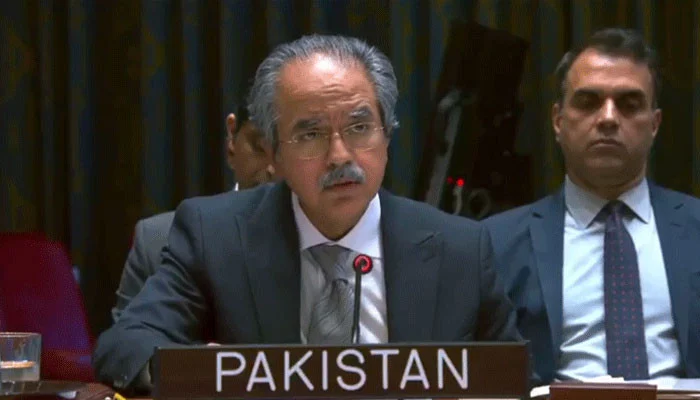
Pakistan has formally told the United Nations Security Council that it will act in self-defence against terrorist threats coming from Afghan soil, whenever such a response becomes necessary. The statement came from Pakistan’s Permanent Representative to the UN, Ambassador Asim Iftikhar Ahmad, during a Council session on the deteriorating security situation in Afghanistan.
Ahmad said any Pakistani response would stay within the bounds of international law and international humanitarian law. He added that Islamabad has already seen a sharp jump in attacks planned and launched from across the border, many carried out using weapons left behind after foreign forces withdrew from Afghanistan.
Background
Tensions between Pakistan and the Afghan Taliban government have been building for years, but they’ve sharpened noticeably in recent months. Pakistani officials have repeatedly accused Kabul of allowing groups like the Tehreek-i-Taliban Pakistan (TTP) to operate from Afghan territory without interference.
The Taliban administration has consistently pushed back on these claims, insisting it does not permit its territory to be used against neighbouring states. That denial hasn’t stopped Islamabad from raising the issue at nearly every available international forum, the UN Security Council included.
Pakistan has also carried out cross-border strikes in the past against what it describes as militant hideouts, actions that have occasionally triggered direct clashes between Pakistani and Afghan forces along the border.
What Was Said at the UN
Speaking during the Council debate, Ambassador Ahmad accused elements within the Taliban of returning to old habits, providing safe haven to armed groups rather than moving against them. He linked this, without naming India directly, to what he called an outside actor exploiting the situation to wage a proxy campaign against Pakistan.
The ambassador’s language was blunt. He told the Council that Pakistan would not remain passive while its citizens are killed in attacks traced back to Afghan territory, and that Islamabad reserves the right to defend its sovereignty and territorial integrity by whatever means are needed.
At the same time, he left the door open to dialogue, framing self-defence as a fallback rather than Pakistan’s preferred path. The distinction matters diplomatically. It signals that Islamabad still wants engagement with Kabul, even as it prepares the legal and political groundwork for further military action if attacks continue.
Quotes From the Session
“We will not sit idle while suffering from terrorist acts,” Ambassador Ahmad told the 15-member Council, according to statements shared by Pakistan’s UN mission.
He also reaffirmed that any Pakistani action would come “in conformity with international law,” a phrasing clearly meant to pre-empt criticism that unilateral strikes inside Afghanistan would breach the country’s sovereignty.
Regional and Global Impact
For the wider region, this is not just diplomatic posturing. Pakistan and Afghanistan share a long, porous border, and cross-border militancy has already led to real military exchanges over the past year, not just statements at the UN.
A more assertive Pakistani posture raises the odds of further strikes inside Afghan territory, which in turn risks pulling in other regional players who have their own stakes in Afghan stability, or instability. Iran, China, and India all watch this dynamic closely, for different reasons.
There’s also a humanitarian dimension the Security Council debate touched on. Afghanistan’s deteriorating internal conditions, combined with cross-border friction, complicate international aid efforts and make the return or resettlement of Afghan refugees an even messier political question.
What Comes Next
Pakistan is expected to keep raising this issue at the UN and other multilateral forums, pushing for what it calls “verifiable action” from the Taliban against groups operating on Afghan soil. Whether that pressure produces any real change in Kabul’s behaviour remains an open question, one that recent history doesn’t offer much reason for optimism about.
Watch for continued diplomatic exchanges between Islamabad and Kabul, along with the possibility of further Pakistani strikes if attacks inside Pakistan continue at their current pace. The UN Security Council itself has limited tools to force either side’s hand, so most of the real pressure will keep playing out on the ground.
FAQs
Is self-defence legal in Pakistan?
Yes. Self-defence is recognised both under Pakistani law and under international law, specifically Article 51 of the UN Charter, which allows a state to act militarily if it faces an armed attack, until the Security Council itself takes the measures needed to restore peace. Pakistan has repeatedly invoked this principle when describing its cross-border operations against militant targets in Afghanistan, arguing that its actions are defensive responses to attacks originating from Afghan soil rather than acts of aggression. Pakistani officials have been careful to frame these operations as proportionate and targeted, aimed specifically at militant infrastructure rather than civilian populations, in an effort to keep the actions within recognised legal boundaries.
Does Pakistan have an air defense system?
Pakistan operates a layered air defence network built around a mix of domestically produced and imported systems, including radar installations, surface-to-air missile batteries, and fighter aircraft tasked with air policing along its borders. The system is managed by the Pakistan Air Force, which coordinates early-warning radar coverage with mobile and fixed air defence units positioned at strategic points across the country. While much of the detailed technical makeup of this network isn’t publicly disclosed for security reasons, Pakistan has periodically showcased elements of it, including missile defence systems, during military exercises and defence exhibitions.
What is the best self-defense weapon in Pakistan?
For ordinary citizens, what counts as an appropriate self-defence weapon depends heavily on local law, since Pakistan regulates firearm ownership through provincial licensing rules that vary from one region to another. Commonly licensed options include pistols and shotguns for home or personal protection, though acquiring and carrying them legally requires a valid arms licence issued by the relevant provincial authority. Non-lethal alternatives such as pepper spray and personal alarms are also used, particularly in urban areas, and generally face fewer legal restrictions. Anyone considering a self-defence weapon should check current provincial regulations first, since requirements and restrictions have shifted over time.
Leave a comment