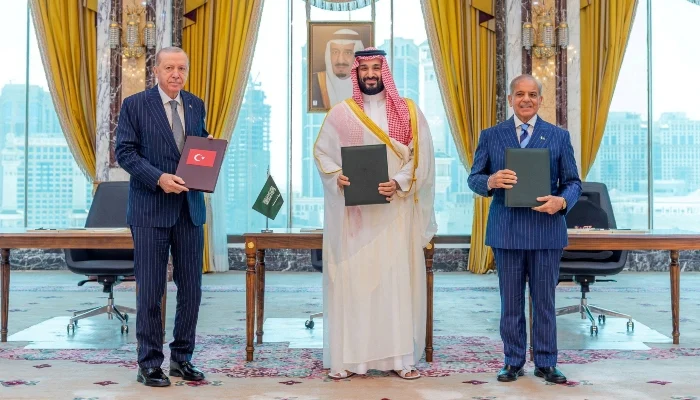

ISLAMABAD: The trilateral defence pact signed by Pakistan, Saudi Arabia and Turkiye in Makkah is being viewed as a major security development, but its long-term impact could extend far beyond defence, potentially opening new avenues for trade, investment, energy cooperation and industrial partnerships among the three countries.
The agreement comes at a time when Pakistan is seeking to revive economic growth, attract foreign investment, increase exports and strengthen energy security. Analysts believe deeper strategic cooperation with Saudi Arabia and Turkiye could create new investment opportunities and accelerate joint economic projects.
The combined economic strength of the three countries adds further significance to the partnership. Turkiye’s economy is valued at around $1.4 trillion, Saudi Arabia’s at nearly $1.28 trillion, while Pakistan’s economy stands at approximately $410-420 billion. Together, the three countries represent an economic bloc worth more than $3 trillion and a combined market of around 380 million people.
Economists say the partnership could provide a strong foundation for greater regional integration if defence cooperation is accompanied by trade liberalisation, investment facilitation and industrial collaboration.
Despite longstanding diplomatic and defence ties, economic relations among the three countries remain below their potential. Pakistan’s annual trade with Saudi Arabia is estimated at around $4-5 billion, while trade with Turkiye stands at approximately $1.3-1.5 billion. In comparison, Saudi-Turkish trade has already surpassed $8.5 billion, highlighting significant room for Pakistan to expand its commercial engagement with both partners.
One of the early economic outcomes of closer Pakistan-Saudi ties could be a proposed $6.7 billion concessional oil financing facility. The facility is reportedly being discussed for a 15-year period, including a five-year grace period, with a proposed interest rate of around one percent.
If approved, the arrangement could strengthen Pakistan’s energy security and reduce pressure on its foreign exchange reserves, particularly amid fluctuations in global oil prices. It would replace an earlier Saudi deferred oil payment arrangement under which Pakistan received around $1.2 billion in financing.
Saudi Arabia has also emerged as one of Pakistan’s major potential foreign investors. Through the Special Investment Facilitation Council (SIFC), Riyadh has expressed interest in investing up to $10 billion in Pakistan across sectors including mining, oil refining, petrochemicals, renewable energy, agriculture, food security, logistics, tourism, ports, industrial zones, healthcare and digital infrastructure.
Potential flagship projects include Saudi participation in the Reko Diq copper and gold project, development of an oil refinery and petrochemical complex, renewable energy projects and large-scale logistics infrastructure.
Analysts believe the new strategic framework could accelerate these initiatives by improving investor confidence and strengthening long-term economic ties between Islamabad and Riyadh.
Turkiye, meanwhile, could complement Saudi Arabia’s financial resources with its industrial expertise and manufacturing capabilities. Turkish companies have already invested more than $2 billion in Pakistan and completed numerous projects in construction, transport, municipal services and infrastructure.
The latest strategic cooperation could encourage additional Turkish investment in defence manufacturing, aerospace, engineering, renewable energy, industrial machinery, railways, urban transport, healthcare technology, information technology, food processing and automotive engineering.
Experts say the success of the trilateral partnership will ultimately depend on how effectively security cooperation is translated into concrete economic initiatives. If investment commitments, trade agreements and joint industrial projects move forward, the Makkah pact could become a catalyst for a broader Pakistan-Saudi Arabia-Turkiye economic partnership.